Sales & Business Growth
Calendar & Application Tactics: How I Book Sales Calls for Maximum Profit
I run two companies — Client Ascension and List Kit — and we're doing somewhere between $1.2 and $1.4 million per month. I personally take home hundreds of thousands in profit each month. I'm telling you that not to flex, but so you understand that what I'm about to share is coming from experience, not theory.
Let's talk about how to book sales calls the right way. There are three things that matter: availability variance, friction, and speed and momentum.
1. Availability Variance
What you're trying to optimize for is simple: get qualified leads to show up, receive an offer, and close. Everything else is downstream of that.
A massive determinant of whether people show up is convenience. The single biggest mistake I see beginners make is keeping their calendar open for only a 3–4 hour window. That's a disaster.
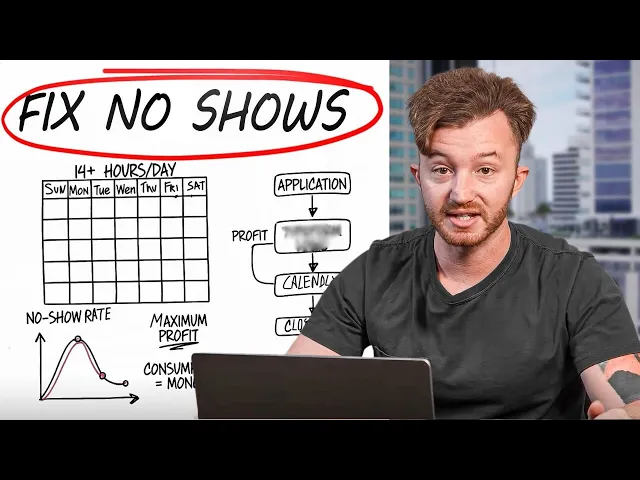
When you're below $20–30K/month, keep your calendar open for 14 hours a day. Make it insanely wide open. Even now, with a sales team of 15–16 people, we hire across time zones specifically so we can have availability from 4 a.m. to 7 p.m. That's not an accident — that's strategy.
Here's why it matters: every person has their own schedule, their own preferences, their own optimal time to get on a call. I personally only like to take calls between 12 p.m. and 2 p.m. If the only available slot is at 5 p.m., that's a disturbance to my day — and when something is a disturbance, the probability of a no-show spikes.
The fewer time slots you have available, the higher the chance any given slot is inconvenient for any given person. That inconvenience compounds directly into no-shows, which compounds into fewer offers, which compounds into less money. It's a death cycle.
Also understand: your no-show rate is not static. One week it's 62%, the next it's 84%, the next it's 50%. This is just how reality works. At scale it doesn't smooth out — it actually gets more volatile and stresses you out more. When people quote their no-show rate, they're quoting an average over a long period. Don't expect week-to-week consistency.
2. Friction
There are two types of friction: qualification friction and tech friction.
Qualification friction = making prospects self-qualify before they can book. This is good. You want this.
Tech friction = unnecessary steps that make it harder to actually complete a booking. This is bad. Eliminate it.
For inbound leads, I use Typeform with point-based lead scoring. Here's how my application logic works for my B2B cold email offer:
Collect contact info first (Typeform's own data shows this increases completion rates)
Ask for their website — we literally won't work with someone who doesn't have one
Ask if they sell B2B or B2C — if B2C, rejected immediately
Ask if their TAM is over 15,000 people — if not, and they won't expand, rejected
Ask for monthly revenue and investment budget — these get scored with points
Based on the score, they get routed to different calendar URLs — highly qualified leads go directly to a closer, mid-tier go to a setter, low scores get rejected outright. I'm not wasting ad spend training my pixel on people I can't work with.
On the tech side: I switched from Calendly to Chili Piper specifically to eliminate re-entry friction. With Calendly, qualified leads have to enter their contact info on the Typeform and then re-enter it again on the Calendly. That's unacceptable. Chili Piper lets me pass contact data through the URL so it auto-populates — they just pick a time and they're done. Chili Piper is expensive, but at our scale it's absolutely worth it.
One important note on outbound: If you're doing cold email, cold DMs, or cold calling and someone responds positively — do not send them a Typeform. You will get zero completions. Zero. With outbound, qualification happens manually on the phone. That's the price of not doing content or running ads. Your setter is the Typeform. Accept the labor cost or tighten your outreach list using AI to pre-qualify leads before you even send.
3. Speed and Momentum
When someone books a call, their excitement is at its peak. That's the moment to strike.
Call or text them immediately and offer to do the call sooner. If you have availability right now, just do it. Don't let a week pass before their call — life happens, interest fades, they find something else. Get them while they're hot.
Run pre-call sequences. Between booking and the call, you should be flooding them with case studies, FAQs, and content. I retarget everyone who books a call with video view campaigns on Meta using my YouTube content and FAQ videos. They're seeing a ton of me before we ever speak. Why? Because consumption equals money. The more someone consumes of you — reads, watches, listens — the higher the probability they show up, buy, and don't churn. Increase consumption as fast as you can.
For beginners especially: 10 calls in 2 days is better than 10 calls in 2 weeks. You need reps. You need volume. You need to batch your calls and do as many as fast as humanly possible. You're not going to get good at sales on a low frequency. Stop delaying, stop spacing things out — get the momentum going and keep it going.