Entrepreneurship
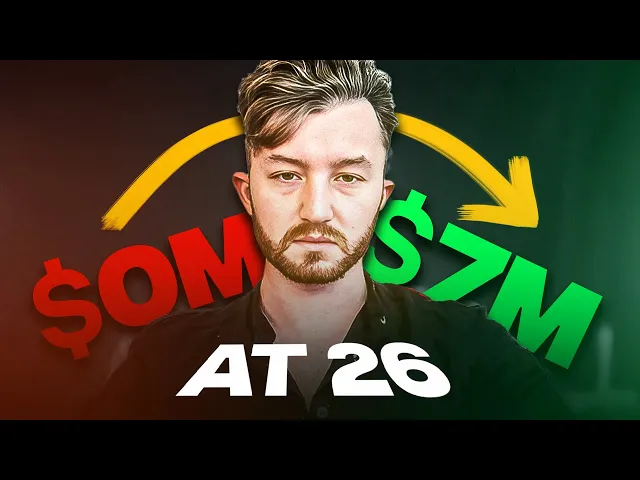
How I Went From $0 to $7 Million by 26 (My Full Story)
I started exactly where most of you are right now — zero skills, zero income. Today I want to tell you the full story of how I generated seven million dollars by the age of 26.
Graduating Early and My First Real Bet
I graduated Florida State at 20 with a finance degree. The last week of college, I stumbled on a YouTube video: How to Make $10,000 Per Month with Amazon FBA. I watched every video on that channel in three days.
On day five, I walked into a bank with a check for $8,000 — basically everything I had saved from working customer support at Apple and before that, a grocery store — and sent it to China. The banker asked if I was getting scammed. I promised her I wasn't.
Three weeks later, stainless steel beer bottle insulators landed on Amazon. I didn't plan it, but it happened to be right before Father's Day. I sold out every unit in two weeks. On the morning my cruise departed for my graduation trip, I'd already made back the entire cost of the trip before stepping on the ship.
That was my first real taste of money I made myself, online.
I rolled all the profits back into more products. Lost everything.
The Instagram Growth Agency
A friend showed me guys on Instagram driving Maseratis, flexing their agency income. Cringe? Yes. Did it work on me? Also yes.
I dug into what they were actually doing — running Instagram growth agencies using a method called follow-unfollow. It doesn't work anymore, but it absolutely cooked back then.
I went back to YouTube, learned the software, learned the process. But nobody was going to pay me without proof it worked. So I hit up friends from college and offered three months of free Instagram growth in exchange for before-and-after screenshots.
Three months of work, basically zero dollars. But when I put those screenshots on a landing page and started cold emailing, I went from zero to $12,000 per month in about six months.
As a 21-year-old, that number felt insane. I was taking girls to Miami, buying friends dinner. Life was good.
Then Zuckerberg changed the algorithm. My clients got warnings that follow-unfollow would get them banned. I lost every client in a single day.
Pivoting to Cold Email
I had no offer left, but I still had the skill that built the business: cold email. So I asked myself — why not sell that skill to other marketing agencies?
I built a cold email agency, ran it for about a year and a half, then started a Twitter account called Cold Email Wizard. To get more clients, I launched a low-priced course called Cold Email Mastery.
That course made $1.1 million.
While selling it, I kept pointing people to third-party software tools — one to find emails, one to send them. Eventually I asked myself: why am I sending all this traffic to companies I don't own?
So I built the software myself. Six tools in total. Some failed, some worked.
Along the way I met my business partners Andre, Christian, and Dan. Together we run Client Ascension — a coaching program helping agencies grow with cold email, plus a recruiting arm that places commission-based cold emailers inside B2B companies. We have 32 team members.
The Four Things That Actually Got Me Here
1. Get Social Proof First — Even If It Means Working for Free
Your income is directly proportional to the proof you have that you can get results. It's the classic chicken-and-egg problem. The client comes first, so you can get the case study.
No one is paying you $3,000–$5,000 a month if you can't prove you can do the thing. I've seen people do all kinds of mental gymnastics to justify why you shouldn't work for free. It's nonsense. Everyone who ever built anything real worked for free at some point. Get the before-and-afters. There's no shortcut.
2. Exist on the Internet
When someone gets your cold email, their first instinct is that you're a scammer. So they Google you. They check your website. They look for your YouTube, your Twitter, your LinkedIn.
If nothing comes up, you don't exist. And people don't wire money to people who don't exist. You have to make content. It doesn't have to be perfect — it just has to be there.
3. Stick to One Business Model
Every time you switch offers, you reset your compounding progress. You don't need 32 businesses making $50 a month. You need one business at $10K, then $20K, then $30K.
Each revenue level requires you to become the person who can operate at that level. You can't skip it. You have to earn it by getting there once.
4. Stick With It Long Enough for Conversion Cycles to Work
People don't buy immediately. You're not sending one cold email and closing a $5K/month client on the first call — that's not how this works.
The reason everything feels so hard at the start is uncertainty, not effort. You don't know what platform to build on, what to say on a sales call, how to film yourself. But once you do something successfully for the first time, you never have to do it for the first time again. That uncertainty disappears permanently.
What Was the Actual Profit?
In the early days, margins were 80–90%. Running everything alone, no overhead. But high margins mean burnout, and burnout means no scale.
As I hired people, margins compressed — but that's what enabled me to grow. Out of $7M in revenue, total profit so far is around $2 million.
The margin gets smaller as the business gets bigger. That's the trade. And it's worth it.