Business Growth
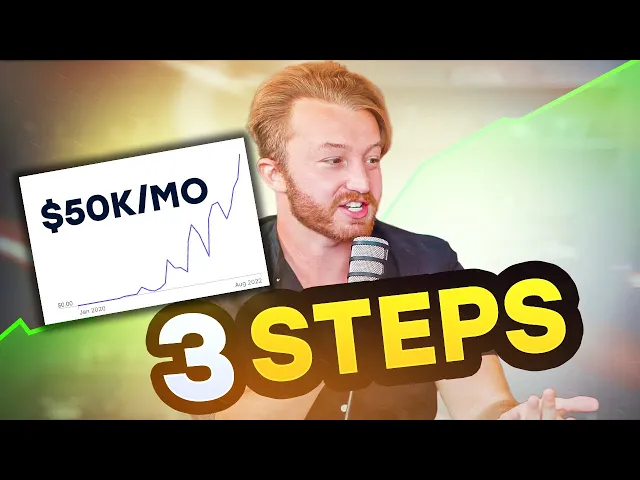
How to Make $10,000–$50,000/Month with Your Marketing Agency (3 Steps)
If you're running a marketing agency, SMMA, or B2B business right now, there's a good chance you're dealing with at least one of these: feast or famine months, can't get people on the phone, deals that don't pay enough, clients churning before you can stack MRR, no defined niche, or zero systems in place.
I've built a marketing agency past seven figures, a consulting company past $2.79M, and a SaaS. I've watched clients go from zero to $20K/month in three months, $42K/month in five months, $100K/month in under a year. This is the framework that makes that happen — three steps.
Step 1: Build an Irresistible Offer
Imagine two houses. One is a run-down shack. The other is a hillside mansion. Both are listed at $100K. Which one is harder to sell?
Obviously the shack. But that's exactly what most agency owners are doing — trying to sell a terrible offer at a premium price. Your job is to build the hillside mansion.
Sell the Transformation, Not the Service
Nobody wants to buy Facebook ads. Nobody wants to buy email marketing. They want more customers, more revenue, more predictability. You need to translate what you do into a concrete transformation — a specific end state your client reaches after working with you.
Stop selling the mechanism. Start selling the outcome.
Reverse the Risk
When prospects ask "what if I don't get results?" or "who else have you worked with?" — that's not them being difficult. That's them telling you they don't trust you yet. It hurts more to lose $100 than it feels good to gain $100. That's the psychology you're fighting.
There are two ways to fix this:
1. Offer a guarantee. Promise a specific result or give a full refund. Work on performance if you have to. Remove the risk entirely.
2. Produce social proof. This is actually your only job as a business owner. Your entire business should be a case study production machine. Every client you get results for becomes evidence that you can take the next person from point A to point B.
Think of it like Amazon reviews. There are two screwdrivers — one has 5,000 reviews at $12, one has 4 reviews at $6. Almost everyone buys the $12 one, even though it's a screwdriver and nothing can really go wrong. That's the power of social proof. You will pay double just because 5,000 people vouched for it.
Every case study you add makes the next sale incrementally easier. Getting your first client is the hardest it will ever be. After that, it compounds.
Step 2: Nail Your Lead Generation
There are three main ways to generate leads: cold outreach, inbound content, and paid ads. Here's how to think about each one — especially if you're under $50K/month.
Cold Outreach
Cold email is cheap (under $300/month to run a full system), predictable, and linear — you get results in direct proportion to how much you send. It's slightly time-intensive but extremely effective at early stages. If you're not at $50K/month yet, this should be your primary acquisition channel.
I've watched clients sign $20K–$30K/month deals from cold email, generate 70 leads in a single day, and book 30 sales calls in a week. It works.
Inbound Content
Building a brand on Twitter, LinkedIn, or YouTube takes time — it's slow to start and time-intensive upfront. But it compounds to an almost infinite scale. For B2B and agency businesses, you don't need high production value. You just need consistency. This is a long game, but there's no ceiling on what it can produce.
Paid Ads
Ads are fast and scalable, but expensive — and if you're under $50K/month, you will almost certainly waste your budget before you figure them out. Save ads for when you have cash flow to absorb the learning curve.
The rule: Focus exclusively on cold outreach and inbound content until you hit $50K/month. It costs less than $300/month combined and gives you the lowest risk of burning your runway.
Step 3: Build Fulfillment Systems
Once you're signing clients, the chaos starts — unless you build systems.
The entire point of niching down is so you can do roughly the same thing for every client, every time. When you do that, you can document it. And when you document it, you can delegate it.
Build Your SOPs
Think of it this way: you're writing a course on how to run your own business. Every repeatable task — customer research, ad scripts, outreach sequences, onboarding calls — gets its own standard operating procedure. Record yourself doing it on Loom. Drop it in Notion. Train a VA to handle it.
Then you eject that VA into your business and suddenly the work that needs to get done for every client just gets done.
For an ad agency, your fulfillment SOP might look like: customer research → extract angles → write ad scripts → source UGC creators → deliver products → collect creatives → launch → scale. Each of those steps has sub-steps. Each sub-step has a documented process.
Three Departments, One Machine
At a high level, your business has three departments: lead generation, sales, and fulfillment. Each one is essentially its own mini-business with its own processes and outputs. It feels messy at first — and that's fine. Let it be dirty. You learn what works by doing it, then you document it, then you hand it off.
The first time you successfully delegate a process and watch it run without you, it's genuinely incredible.
Those are the three steps: an irresistible offer built on social proof, a lead generation system anchored in cold email and content, and a fulfillment engine built on SOPs. That's the whole game.