
Agency Growth
How I Model an Agency’s Acquisition, Sales and Fulfillment System
· Updated
I think about an agency as a connected system: the offer, the people reached, the response process, the sales conversation and the work delivered. A weak point in one part can change the economics of the whole thing. In this walkthrough, I use financial models and channel processes to show what I would measure rather than choose a tactic only because it feels promising.
Qualify the buyer before arguing about the close rate
I ask whether a prospective client has the resources and business economics to support the service. A professional-looking site or confident presentation is not a substitute for discovery about what the business actually does and can afford.
The reason qualification belongs in the model is that buyer fit can affect the amount charged, the sales process, retention and the work required to serve the account. My emphasis is selecting a workable commercial relationship rather than measuring success only by how many calls close.
Separate acquisition cost from lifetime gross profit
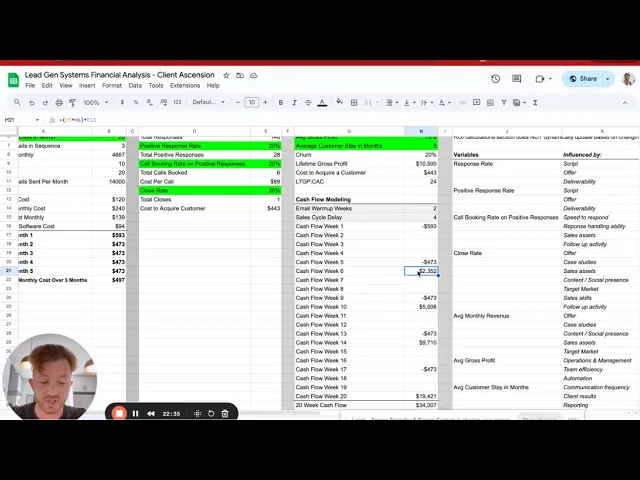
My first illustration assumes $30,000 of acquisition spend and a $300 cost per qualified call. That gives 100 calls; with an assumed 15% close rate, there are 15 customers and a $2,000 acquisition cost per customer.
The same illustration uses $3,000 monthly revenue per customer, a 70% gross margin and a modeled five-month customer lifetime. Those assumptions give $10,500 of lifetime gross profit per customer and a lifetime-gross-profit-to-acquisition-cost ratio of 5.25. This is a hypothetical model, not realized customer profit or immediate cash collected.
I use the model to examine how qualification, price, retention and conversion interact. The targets I argue for in the lesson are my operating guidance; the spreadsheet is not evidence that one fixed ratio guarantees a scalable business.
Account for time and the delay before a sale
Spend is not only advertising. I explicitly include the value of manual outreach time and the hard costs of domains, inboxes, data and tools. A free sample also has a cost, whether I make it myself or pay somebody to make it.
I then model activity happening before the resulting sale. The example includes setup and a sales-cycle delay, so costs appear before customer payments. The practical question is whether the business can support that delay, not whether an early week of spend automatically proves the system has failed.
A forecast with constant response, closing and retention assumptions is still a scenario. The modeled growth depends on those inputs holding; it is not a promised month-by-month income schedule.
Build the cold-email process beyond the send button
The outbound flow I describe includes a lead list, sending infrastructure, different offer approaches, response handling, follow-up, meetings and a paying client. The approaches include a lower-risk introductory offer, the main service, a useful video and relevant case evidence.
I want the offer, response speed, follow-up, deliverability and message working together. To compare approaches, I look at response rate, positive responses, bookings, closes and their associated costs instead of asking which script I personally feel best about.
Use tailored work for a smaller set of prospects
For Dream 100, I identify a small set of suitable prospects and prepare something specific: a useful deliverable, an audit or an introductory service. A designed email, email sequence or scripted video gives the recipient actual work to examine.
The effort belongs in the cost model. Cost per deliverable, the proportion producing a meeting and the close rate determine the acquisition cost; free to the prospect does not mean free to the provider. I also describe following up rather than expecting the first delivery to finish the sale.
Client Ascension related reading: Areeb's content agency case study is a separately attributed operator account, not validation of every modeled conversion rate.
Make useful content for a buyer researching the work
For evergreen YouTube content, I look at questions the intended customer searches while considering doing the work themselves. I examine relevant competitor videos, unusually strong examples and what existing search results explain, then make my own useful version.
The teaching can be a detailed screen-share rather than an entertainment production. I connect the video with a relevant offer or opt-in and subsequent follow-up. The modeled compounding of views in the lesson is an assumption, not proof that keywords or a posting schedule produce predictable search rankings.
Connect social activity with conversations
I describe LinkedIn and Twitter as related processes: a clear profile, useful or authoritative content, stories and relevant interactions. Comments, replies and direct conversations can connect to tailored work, an introductory offer or the main service.
I still want to measure the path into sales. Activity on a platform is not the same as a customer; the process must connect interested people to an explanation, a conversation and suitable delivery.
Maintain the sales and fulfillment operation
The wider system includes a CRM, follow-up, sales scripts and call review, as well as onboarding, SOPs and people responsible for delivery. In the walkthrough I describe tracking the numbers and improving the weak parts rather than hiring a team and ignoring the operation.
This is why the parts need to be considered together. Acquisition has to produce workable clients, sales has to explain a deliverable the team can fulfill, and fulfillment has to support keeping those clients.
Client Ascension related reading: the agency bottleneck guide describes another example of identifying the constraint before adding more traffic.
Adapted by Client Ascension with AI assistance from Daniel Fazio's lesson. The first-person narrative follows the source speaker’s account. Watch the original video





