Agency Growth
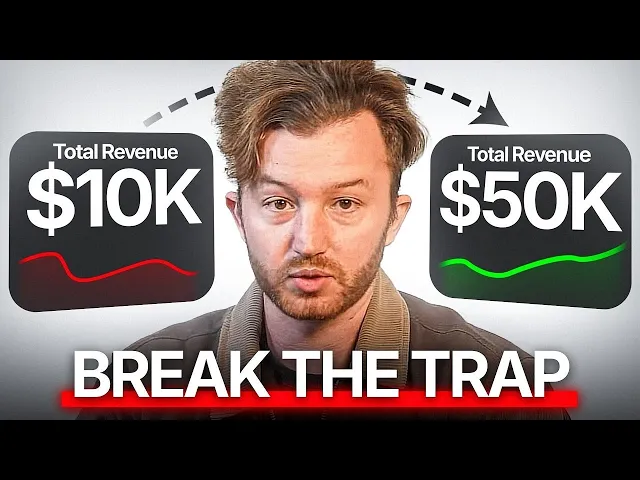
If I Were Stuck at $10K/Month, This Is Exactly What I'd Do
If your agency is stuck at $10K a month, I'm going to tell you exactly what's wrong — and it's probably not what you think. It's not your offer. It's not your case studies. It's not your sales skills. It's a demand problem.
Why You Can't Charge More (Yet)
Your ability to charge a specific price is a function of how many people demand your services relative to how much capacity you have. That's it.
When demand is low, you have zero pricing power. You take whatever you can get, charge less than you should, and spend your time on low-quality clients because you're terrified of losing anyone.
Think of it like a housing market. If a city doubles its population but adds zero new housing units, prices double. Same principle applies to your agency. When demand outpaces supply, your prices go up — without you changing a single thing about your service.
Most agency owners are stuck in one of two modes:
Taking any client at any price because losing one feels catastrophic
Busy but flat — making decent money, but one lost client immediately stings
The path out isn't a better script or a sharper offer. It's more demand.
The Death Spiral No One Talks About
Here's what happens when you don't have consistent lead flow: you rely on referrals. Every client becomes irreplaceable. You can't risk losing anyone. So you undercharge — taking $1,500 projects that should be $6,000. That low-value work consumes your entire day, leaving zero time to build the outbound system that would have solved the problem in the first place.
I coached someone through this recently. He runs an automation agency, 12 clients, solid results. Clients kept asking him to build complex automations worth $6,000+ in his time. He was charging $1,500–$2,000 because he was afraid to offend them.
The real issue? His entire pipeline came from referrals inside one franchise network — people who literally could not afford $6,000 projects. You can't fix that by just saying a bigger number. You need exposure to people who can actually pay that price.
The way you get over a breakup is by finding someone new. Same logic applies here. Stop trying to squeeze more out of the wrong audience. Go find the right one.
Why Rejecting Bad Clients Feels Impossible
Scarcity doesn't just make you undercharge — it makes it nearly impossible to say no. If you're getting six qualified calls a month and rejecting four of them, you sign two clients. That feels devastating. Every rejection hurts.
But if you're getting twelve qualified calls and rejecting four, you sign eight clients. Same standard. Completely different feeling. The selectivity didn't change. The volume did.
One person I worked with hit exactly this wall. His Twitter and LinkedIn content had plateaued. He was getting a stable, predictable number of leads — and that number wasn't going to magically grow. He'd hit the local maximum of his channel. The answer wasn't to lower his standards. It was to add a new channel and double his call volume.
The Three Demand Channels
Outbound (Cold Email, Cold Calling, Marquee Method)
Fast, cheap, and you control it completely. Send more, get more. It's linear — it doesn't compound — but it works immediately. If you're stuck right now, outbound is where you start.
Content (YouTube, Twitter, LinkedIn)
Slow to build, but high ceiling. The problem is most people hit a local maximum where growth plateaus unless your content consistently improves or breaks through algorithmically. Great long-term play, but don't rely on it alone.
Paid Ads
High ceiling, but high capital barrier. B2B customer acquisition costs run around $3,000. Expect to spend $5,000–$10,000 before your first close due to sales cycles. Only pursue this once you have cash to stomach the lag.
Start with outbound. Add content. Add ads when you have capital.
The 4-Stage Demand-to-Pricing Progression
Stage 1 — No pipeline (0–5K/month): All clients come from referrals. Start cold outreach immediately. 500 cold emails a day. Marquee Method. Just generate demand.
Stage 2 — Low volume (5–30K/month): You have outbound running but only 4–6 qualified calls a month. Double or triple your send volume. Add a second channel. Going from 6 to 12 qualified prospects changes everything.
Stage 3 — Sufficient volume: You're getting 10–15+ qualified prospects monthly. If your close rate is above 40%, your price is probably too low. Raise it incrementally and track the data — no gut feelings, just numbers.
Stage 4 — Premium pricing (30K+/month): Demand far exceeds your supply. Now you either add team members to expand capacity or keep the business small and high-margin. Both are valid.
How to Diagnose Where You're Stuck
All clients from referrals? You have no demand system. Start outbound this week.
Running outbound but only 4–6 calls/month? Volume is too low. Scale what's working.
Closing 40%+ of calls? Your price is too low. Test raising it and watch the close rate.
Signing bad-fit clients despite decent volume? You have enough demand — give yourself permission to say no.
Hit a revenue ceiling despite good results? You've maxed out your current channel. Add outbound or ads.
One important note: what you can charge is also a function of your authority and social proof. Case studies, client results, positioning — these all matter. This isn't purely a numbers game, but for most people stuck at $10K a month, the volume problem comes first.
More demand creates options. Options create confidence. Confidence holds price. That's the entire equation.
If you want help building this out, check the link in the description for Client Ascension — that's where I show people exactly what to sell, who to sell it to, and how to get clients using AI.