
Business & Marketing
What to Sell First: How I Pick Markets, Offers and Pricing
· Updated
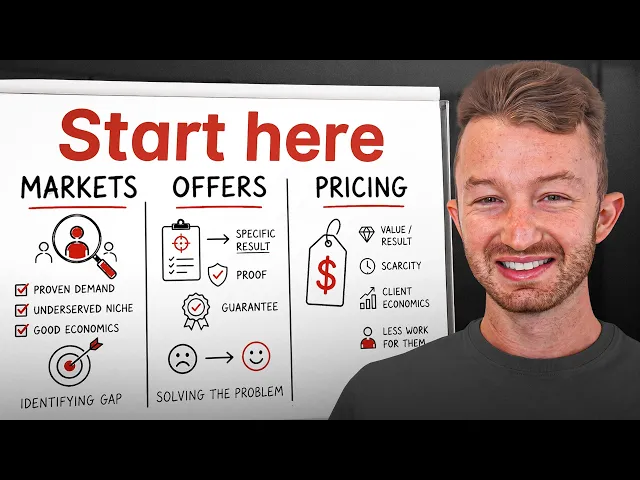
When I choose a market, offer and price, I start with a service people already buy. Then I test who responds, check the buyer's economics and make the offer specific enough for a stranger to understand.
A familiar service does not remove the work of selling and delivery. It gives me a clearer starting point than trying to persuade a buyer to want an unfamiliar category and buy it from me at the same time.
Start with what people already buy
If I invent a category, I have to convince a customer they need it and then convince them to buy it from me. I prefer starting with a problem and a service buyers already recognize.
I look for a service that already has buyers and study its structure. That gives me an existing market to test instead of having to establish demand for a new category at the same time. It does not remove the need to sell and deliver the service.
Treat saturation as evidence
I see far more people walk away from crowded markets than I see people fail inside them. Beginners look at a busy market and assume it's closed. Usually a crowded market means people are paying.
Lead generation is the example I use: seeing other agencies sell it tells me there are existing buyers. I would still test a specific segment rather than assuming that a busy market makes my offer work.
Client Ascension related reading: the client acquisition guide discusses matching channels to an offer and judging cost per client over a full sales cycle.
Copy the structure, not the surface
When I say copy, I don't mean copying someone's logo or landing page. The surface design is not the part of the offer I'm trying to copy. What I copy is the structure of the offer underneath it.
Those structural choices decide whether an offer sells. I can change the look of a page all day and still have a weak offer. These are the questions I'd answer before I write a word of copy.
Who exactly is the target customer?
What specific result is promised, and by when?
What guarantee is offered, and how is it defined?
How is the offer priced, and where does traffic come from?
What proof and case studies support the claim?
Test niches before you specialize
I have seen people spend months or years on a customer segment that is too small for the scale they want. In the lesson, I used a hypothetical market of around 10,000 people to illustrate the problem: outreach and ads can eventually run into the size of the reachable audience.
So I'd test a range of niches with real outreach. Do they respond? Do they understand the offer? Do they have the problem, can they afford it, and do they buy after the call? Specialize only after results show where you're strongest, not because you happen to know people in one industry.
Count the real buyers in a segment before you commit.
Test 15 or 20 niches with real outreach rather than guessing.
Specialize only where you can sign and deliver more easily than elsewhere.
Choose clients whose economics can carry you
Your client's economics affect what they can pay you. I used a $15,000 customer lifetime value as a general filter in the lesson, ideally higher, because acquisition cost and cost of goods also have to fit. That was my starting preference for selecting clients, rather than a universal minimum for every service.
I also prefer winners who lack capacity. They're growing, they have a sales team and they need more calls or customers. Struggling businesses may not have the money to pay, and I prefer clients whose demand and capacity make the service a better fit.
Before I sign anyone, I make sure they can do their part. They need to call leads quickly, keep inventory in stock, handle the volume and know how to close cold prospects. If results stall, the reason should be visible from day one.
Build an offer cold traffic will buy
I describe warm traffic as people who already know, like and trust you. Cold traffic needs a more concrete reason to buy: a defined outcome, proof and a way of reducing perceived risk. A generic consulting call is a different sale from a clearly packaged service.
My cold-traffic triangle is a quantifiable result, proof such as case studies, and a guarantee. I use it as a way of checking the offer: aim to have at least two of those elements and use all three when they fit. The offer also needs a reason to care that can be explained in one sentence.
I also adjust four dials. The more of these favor the prospect, the more the offer tends to sell.
New money the buyer doesn't already have
Done for you delivery that takes logistical weight off them
De-risking through a guarantee or a performance basis
Low commitment, such as month-to-month terms
Guarantees, pricing and the work you absorb
I argue for promising the deepest outcome you can support, with clear definitions and responsibilities. Leads, booked calls, attended calls, signed clients and revenue are different results. If the client must provide access, follow up with leads or close the calls, those requirements need to be explicit.
Performance pricing can itself be the risk reversal. In the lesson's example, the client pays a $600 monthly tech fee plus $200 for each booked call. I was showing why pay-as-results-arrive differs from a retainer plus a separate result guarantee; those figures were an example, not a current price list or a universal rate.
I also keep the menu short. Don't mix more than two charging methods, because clients feel nickel-and-dimed. When I raise prices, I do it in steps. Try 10 or 15 percent, watch close rates over about 30 calls, then decide whether to go again.
I use a hypothetical comparison between two roofing lead-generation agencies. Both run the marketing, but one also calls the leads and schedules quotes. If doing that work costs around $1,000 a month, I argued the agency could charge more for taking the burden off the client's team. It was a pricing illustration, not a measured margin or a promise of a particular markup.
I also described an agency owner who changed his offer for attorneys and later sent me a screenshot of a stronger result. That was an individual example of changing the pitch, rather than evidence that a new headline will produce the same outcome elsewhere.
Where I'd start
If you're just starting, I'd settle these decisions before you sell anything. Write the offer as one sentence: the customer, the result, the timeframe, the guarantee and the pricing. If it still sounds valuable when it's that short, you're closer to something worth testing.
Most of the mistakes I see come from skipping the tests. Choose a market that already buys, test niches instead of defending a guess, and let the client's economics decide what you can charge. That's where the real leverage is.
Client Ascension related reading: Dan’s HubSpot agency account discusses pricing, positioning and partner channels.
Adapted by Client Ascension with AI assistance from Daniel Fazio's lesson. The first-person narrative follows the source speaker’s account. Watch the original video





