
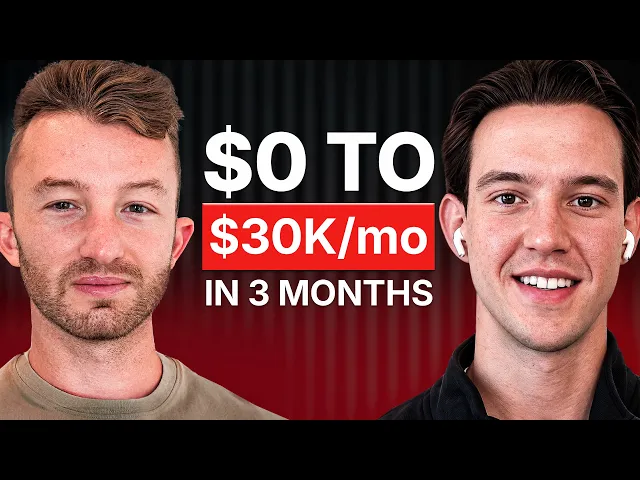
Why I Replaced Custom AI Projects With an Outbound Agency
On paper, my AI automation agency sounded fine. In practice, I was mostly working alone, getting most of my work through Upwork, and I could only handle two or three clients at a time.
I stopped selling custom projects and picked one core service I could deliver the same way for different clients. That was the repeatable business I had wanted to build.
The interviewer asked whether I had gone from zero to 30K a month, and I confirmed that it had happened in three months. The interviewer explicitly described that result as uncommon. I did not give a profit breakdown.
Why Custom Work Kept Me Stuck
Before I joined AI Assisted Agency, I was running an AI automation agency that I describe honestly as a glorified freelancer. I had one person I partnered with on some builds, and the rest of the work came in one project at a time.
Every project was super custom. A client would post a problem, and I'd take it on and get deep into the weeds. The cash flow was decent, but I felt more like an automation person on someone else's team than the owner of a business.
What I wanted was something repeatable with better margins and room to grow. Doing one core function for someone over and over is what I was missing.
Shutting Down the Old Business on Purpose
I didn't keep the AI automation side running alongside the new work. I fully turned that business off, stopped accepting clients there, and referred any inbound work elsewhere so I could focus on outbound.
At the interview, I had ten clients getting the same service. I could get good at that service, hire people and run it as a company rather than handle every project as a separate custom build.
How the Pricing Changed
My first deal was around $1,000 a month. The client paid the infrastructure for inboxes and domains directly, and I included a meeting guarantee. I recalled it as around five meetings a month, rather than a precise rate card to copy. I later changed that structure.
I moved to a performance model where the client pays an infrastructure fee and then a set amount for each meeting. People seem to understand that model much better, because they're only paying for results. It also pushes me to improve those results. At the interview, we were still using that pricing model with many clients.
Private equity is different. One deal has no infrastructure fee, a higher per-call rate, and a percentage tied to closing the deal, which is much longer-term. Retainers are also starting to come in, usually after a referral, with a client who has worked with us before, or with an inbound lead who already sees us as an authority.
Early deal: about $1,000 a month plus infrastructure fees, with a meeting guarantee
Performance model: infrastructure fee plus a charge per meeting
Private equity: no infrastructure fee, higher per-call rate, and a percentage if the deal closes
Picking an Offer With Demand Already There
Early on, I thought I had to invent something nobody had tried. That's how I approached my software company, and the odds of landing product-market fit that way are low. Once I switched to finding something with existing demand, customers and cash flow started showing up.
I wanted an offer that already had demand in the market. I pointed to outbound lead generation as a service businesses needed, rather than trying to invent something nobody had bought before.
I also learned that offers can be reshaped. One marketing client had brand advisory, which is a hard offer to run. Our early results were okay but not special, and I suggested we stop. A couple of months later they came back, and this time I pitched several campaigns. Some led with a growth guarantee, others led with higher-demand services with the brand work on the back end. And that's been absolutely crushing.
Running Our Own Agency Like a Client
Outbound has a big advantage: the marketing I do for my own agency is the same motion I deliver for clients. When we build a better list or find copy that works, we can use it for clients and for us. Each improvement helps both sides.
We treat our own agency as an eleventh client, with the same list building, copy and campaign launches. We also handle things we don't do for clients, like LinkedIn, conferences and brand building, and sales calls take a big chunk of my time.
For a while I split my time roughly 50/50 between sales and marketing and delivery. I'm now hiring on the delivery side, which frees up time for sales. We use AI across the stack too, which keeps the team lean.
Volume and Speed Matter Once Deals Are Real
I signed my first client within a week or two. I already had email infrastructure ready, and I started sending real volume with an offer that already worked and performance pricing. I don't think sending a lot is scary. Too many sales calls is a good problem to have.
At the interview, I put sending volume for my own agency at about 6,500 a day. I wanted to reach 10,000 a day; that was a target, not a volume I had already reached.
Speed matters on the sales side too. When a deal looks real, I try to get a proposal out within an hour, ideally signed that same day. I built a workflow where the call transcript becomes a customized proposal, so the client can sign and pay right away.
What I'd Do Differently Starting Now
I try not to get stuck on shiny tools, data providers or mailbox decisions. Some choices barely matter, and a quick test gives you data faster than a week of debate. I make the decision, launch the test, and learn from what happens.
Testing offers yourself teaches more than watching videos. Launch the campaign, see whether it worked, and if it didn't, you've learned what doesn't work. Reflection matters too, and I'm still working on asking why one thing worked and another didn't.
I also look back at what a test taught me instead of just moving to the next tool. Learning from other operators helped, but I still had to put the offer in front of buyers and learn from their responses.
Client Ascension related reading: the client acquisition guide discusses matching channels to an offer and sustaining lead generation.
Adapted by Client Ascension with AI assistance from Oleg's interview. The first-person narrative follows the source speaker’s account. Watch the original video





