
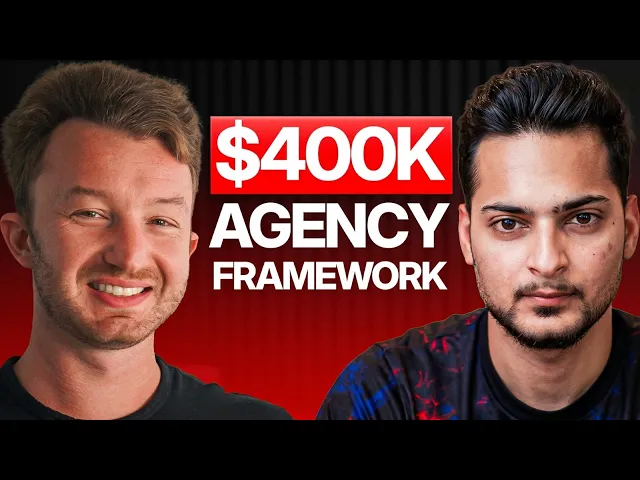
How I Built My Content Agency to a Reported $400K Month
I'm Areeb. I run a content agency with physical studios in Houston and Dallas. When I joined Client Ascension in 2024, I was doing roughly $28,000–$30,000 a month. At this interview, the business had hit a $400,000 month.
The work between those points was not only finding more customers. I had to get out of fulfillment, make the offer more specific, build a sales team and reorganize how the delivery team handled capacity. The monthly business figure was not a disclosed profit figure.
I could not grow by doing every part of fulfillment
At the earlier stage, I was saying yes to every deal and spending long days doing the work. I could not see how to grow further with no hours left. Andre encouraged me to hire, train people properly and bring myself out of fulfillment so I could spend more time on marketing and sales.
My offer was vague, and I was hesitant about making a guarantee. I worked on making the offer specific instead of trying to sell a general bundle of marketing work.
Local studios changed the sales conversation
The offer was done-for-you content services, starting with an offer of one million views in ninety days. That was the offer we sold, not a claim that every client achieved that result.
For local clients, the physical studios mattered. People could visit, meet the team and shake hands. I said that made closing simpler and that local clients stayed longer. It was why I was focusing more on Houston and Dallas rather than treating the national market as automatically better.
For remote customers, we used a Riverside setup with a director joining the recording. We prepared scripts, helped the client set up to record and then passed the uploaded footage to editing and publishing.
Ads brought prospects in, but the markets had different economics
I reported an average acquisition cost around $2,500 across the markets. Houston was around $1,500, Dallas around $2,500 and the national market more than $3,000. Those were my approximate customer acquisition figures at the interview, not a net-profit calculation.
Earlier, I had used Instagram profile-visit ads and messaged the people following to bring them onto calls. I was already used to speaking with people who had never heard of me. Later, we doubled down on a VSL call funnel and tested the opt-in and application paths.
Client Ascension related reading: the acquisition guide connects those channel decisions with the sales process. It does not make my acquisition costs a benchmark for another agency.
Closing deals and building a sales team were different jobs
At the interview, I was still selling because I liked sales, alongside three other closers. Dan helped me understand how to build that team and the process around it. Being able to close a deal myself had not taught me how to manage a sales organization.
I also hired setters to work more of the leads coming in. On the tracking side, I moved beyond a manual spreadsheet after discussing the numbers on a call. Those changes were part of following up leads and understanding what the funnel was doing.
We reorganized delivery around different capacities
Our old pod structure bundled roles together even when those roles had different capacities. One person was managing too many people, and a pod could be limited by a role that did not need to be the constraint. We moved toward departmental teams, including client success and videography, rather than duplicating the same structure inside every pod.
We had also been hiring an account manager for every five to six accounts. The change was to give each account manager at least ten accounts and focus on hiring fewer, stronger people. I said clients were happier and things ran more smoothly, but I did not supply a measured satisfaction score or a controlled comparison.
Client Ascension related reading: Steven's content agency case study offers another account of delegation and collections. His figures are separate evidence from a different operator.
I tried to identify the department that was actually stuck
My process was to write down where the business needed to improve and get specific help for those departments. I knew operations and sales both needed work; changing the offer again would not solve every operational problem.
I valued being able to test an idea quickly, see what happened and ask for help with the problem that appeared. That does not remove the cost or risk of advertising, hiring and fulfillment. It describes how I worked through my own business, not a repeatable earnings promise.
Adapted by Client Ascension with AI assistance from Areeb's interview. The first-person narrative follows the source speaker’s account. Watch the original video





