
How I Sold White-Label AI Video Ads to Political Firms
I'm Kevin. My AI video offer was built around a market I already knew: political campaigns and the firms that serve them. I sold creative through agencies, used free sample work as proof and kept following up with prospects.
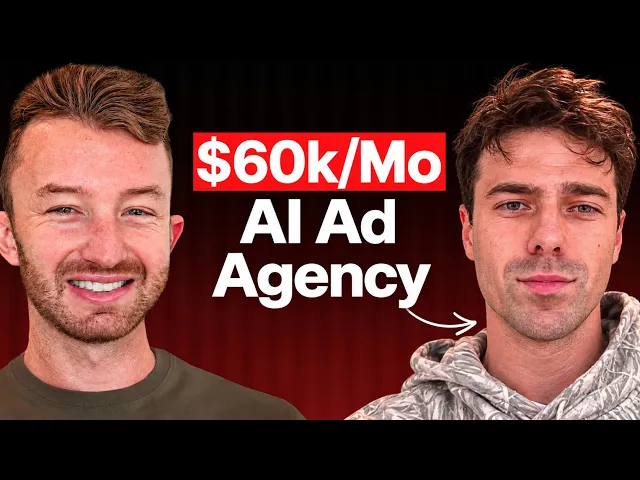
The interviewer introduced my story as reaching $60,000 a month in five months and described it as an unusual result. That interview figure did not show what I kept as profit. The offer, pricing and delivery work were what I explained in our conversation.
Starting over in a market I already knew
Before Client Ascension, I started a company and sold it. After that, I spent months launching around eight different businesses, and almost all of them failed. My focus was all over the place.
Joining the program is what made me zero in. I had one job, which was getting my offer in front of the people who needed it. My student success coach helped with that, along with cold email, a little paid ads, and a lot of Dream 100 research.
I first wanted out of politics. The market is relatively small, it runs on relationships, and the exit from my earlier company wasn't a massive one. But I realized I speak the language these clients speak, so trust comes faster on sales calls.
Why the white label model made sense
In politics, the buyer isn't always thinking about return on every dollar. The consultants and firms I work with do care about results, so they're the ones I actually sell to.
My model is white label. The agencies and firms sell to the campaigns, and my team handles the creative on the back end. Instead of selling one ad for around $10,000, they can offer twenty ads in a month at roughly $3,000 to $5,000 each.
That leaves the agencies and firms room to make money while we fulfill the creative. I described that margin opportunity as the value of the white-label model.
The free sample that became my first case study
The first clients came from a simple pitch. AI video was getting a lot of attention in political circles, so I told people they'd probably seen those videos and offered to make one for free.
We made three videos for a statewide campaign in New York, and we generated about 10 million organic views on social. Views aren't revenue, but that result became my proof. I used it in cold emails to other campaigns and firms: here's what we do, can we do it for you?
Making the ads without being a great editor
Until about three weeks before the interview, I had been making every video myself. I did not start as a strong editor; I learned through YouTube and practice, and developed an eye for assembling the visuals.
I learned a lot of the AI process from Camilo inside Client Ascension. At the time of the interview, I was still working very long days and needed better systems and help with delivery. A repeatable process did not mean the work had become effortless.
Following up after the first conversation
People forget you, even after a good call. One client I had been following up with for four months finally came back with a project and said I'd be perfect for it. We closed an $8,000 deal that day.
It sounds simple, but it's easy to get tangled up and skip the follow-up when you're busy. That's the part I'd tell anyone to protect.
How I think about pricing
I started around $1,500 per video and, by the time of the interview, was generally charging $3,000 to $4,000. A client once compared my $2,000 price with another vendor charging $10,000. That conversation helped me see that I had room to raise prices.
I don't think I need to reach $8,000 or $10,000 per video to have a strong business. As we build more case studies, I expect prices to keep climbing, and $5,000 to $6,000 per video is a realistic target that still lets clients make money. I'm not there yet.
What's hard about this work
Political work often runs on very short deadlines, and when you do everything yourself, that's a grind. I also don't know how to hire well yet, which is part of why I'm staying in Client Ascension. I need to build out operations.
Video is time consuming. You can systematize parts of it, but every project is different, and some clients want ten revisions even when they wrote most of the script. It's easy to underestimate how many hours a week you'll really work.
Where the agency goes next
When we recorded the interview, the approaching midterms made political work busy. I was considering whether to stay in political and public policy work, add ad services or expand into other industries. Those were plans, not results I had already achieved.
The interviewer suggested approaching other companies that already bought commercials, identifying advertisers on streaming platforms and sending a personalized example. I liked that idea. The conversation was about a possible next step, rather than a campaign I had already launched. I also described traditional in-person shoots as costing $30,000 to $40,000 and sometimes up to $100,000; that was my comparison, not a market-wide price survey.
Look at who is buying ads on streaming platforms like Roku, Netflix or Paramount.
Send personalized outreach that includes a relevant example.
Compare the cost of AI production with a traditional shoot.
What I'd tell someone just starting out
If you're on the fence, I was in the same spot six months ago. I watched a lot of case study videos and a lot of Client Ascension content. Many business owners are scattered, with a new idea for every industry, and I was no different.
My advice was to stay process oriented and detach from the outcome: do the daily work, whether that meant five or ten outreach messages. That was advice I gave in the interview, not a measured account of how many messages produced each sale.
Client Ascension related reading: the client acquisition guide discusses matching channels to an offer and sustaining lead generation.
Adapted by Client Ascension with AI assistance from Kevin's interview. The first-person narrative follows the source speaker’s account. Watch the original video





