
Business
How I Organize AI-Assisted Client Fulfillment as a Repeatable Workflow
· Updated
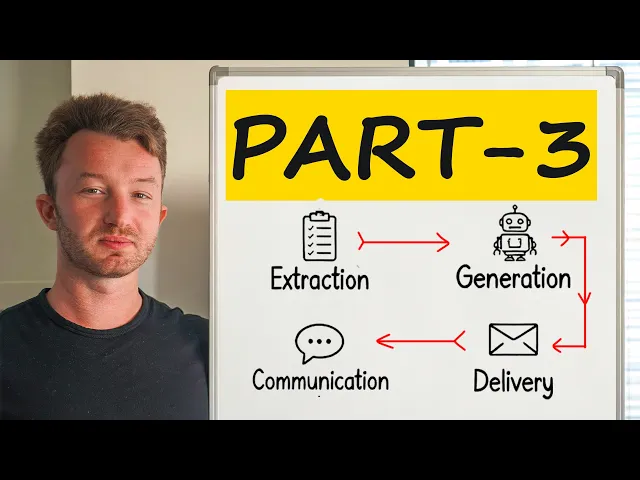
I organize fulfillment into gathering information, producing the deliverables and communicating the output and results. For a one-person operation, I then ask which parts need my judgment, which can be automated and where AI can assist. The aim is a repeatable process with clear stages, rather than start every engagement with an empty prompt.
Distinguish a trigger from the judgment behind the content
Sending a message after a specific event is different from writing a message worth sending. In the lesson, a booked call can trigger an email through a CRM tag or integration; deciding what that email says requires more judgment.
I use that distinction when allocating the work between myself, automation and AI. Automating the transfer of data does not by itself decide the message, strategy or quality of the output.
Collect the information needed for the actual service
At onboarding I want the exact offer, price, deliverables, target customer, objections, sales process and relevant existing assets. Those answers become the client-intelligence document used in production.
I demonstrate asking AI to help design the intake questions for the specific service. The form should collect what is necessary without becoming unnecessarily frustrating for the client.
Useful inputs include past copy, testimonials, case evidence, brand assets and the systems already used. The document gives later production stages shared context instead of making the provider rediscover the business for each deliverable.
Map the work as an assembly line
Each stage should have a task, an owner or tool and a place in the process. My cold-email example separates infrastructure, list preparation, writing, loading, sending, reply handling and reporting.
The ads-and-funnels example instead includes pages, video scripts, creative variations, follow-up messages, campaign setup and client reporting. The sequence depends on the service, even though the method of defining stages is similar.
Client Ascension related reading: the local email-idea workflow shows a narrower example of collecting source material before using AI to organize it.
Use a chain of prompts with a job for each step
The demonstration loads a hypothetical PR client's information, generates possible angles, selects angles, writes variations and then refines the wording. I separate those steps instead of expecting a generic instruction to produce finished client work.
The fictional client's examples are role-play material, not case evidence. The reusable part is the sequence of context, ideas, drafting and refinement, with the real client's information replacing the example.
For a video script, the same principle can mean context, outline, sections and transitions; for ads it can mean hooks, body copy and calls to action. I want the production process defined rather than improvised from scratch.
Check the output before handing it to the client
I explicitly ask whether the output is correct, true and relevant, whether it made anything up and whether the reader has a reason to act. AI-generated copy is not exempt from the checks I would apply to work produced by another person.
Reporting has a similar requirement for real inputs. I describe exporting actual campaign data for analysis, then presenting the numbers and the proposed next actions to the client.
Set the communication expectations at onboarding
I describe agreeing on how questions are sent, when responses should be expected, when reports arrive and how scheduled strategy calls work. Leaving those matters undefined can create incompatible expectations.
The report should show what happened and what the agency is doing next. I give a recurring update cadence as an example of making the work visible, not a guarantee that communication alone makes poor delivery acceptable.
Batch related tasks instead of switching constantly
I suggest grouping onboarding, production, quality review and reporting into blocks. In my own schedule I put filming before lunch and meetings later, because that fits the work and my energy.
The example weekly plan is not meant to be identical for every service. The point is to make room for focused execution rather than have every client message interrupt every other type of work.
Use delivery to improve the next engagement
Client work can produce before-and-after evidence, portfolio material, lessons and improved prompts or systems. I connect those assets with the authority needed to explain the service to future prospects.
The first engagements may expose clumsy onboarding or weak output that needs more editing. I want that learning reflected in the next version of the process, rather than claim that using AI removes the need to become better at delivery.
Client Ascension related reading: the offer-versus-product guide separates what the buyer is purchasing from the way the agency performs the work.
Adapted by Client Ascension with AI assistance from Daniel Fazio's lesson. The first-person narrative follows the source speaker’s account. Watch the original video





