Business Strategy
How to Price Your Services for Maximum Profit (The Math Most Agency Owners Get Wrong)
The Pricing Myth Nobody Wants to Admit
Sometimes you are in fact charging way too much. I know that's not what the gurus were telling you in 2020 and 2021 when everyone was screaming "raise your prices" — but hear me out, because the market has fundamentally changed.
Back when interest rates were at zero and stimulus checks were flowing, the money supply literally tripled. So yeah, tripling your prices made sense. The math worked. But those days are done. Interest rates are up, loans are tight, your clients' businesses are making fewer sales, and consumers aren't getting approved for credit like they used to.
If you raised your prices aggressively during that window and never came back down, there's a good chance you're making little to no profit right now. And profit is the only thing that actually matters in a business.
Why Fixed Expenses Change Everything
Most of you watching this run some form of a marketing agency, and in that model roughly 70% of your expenses are fixed. That means you're paying the same amount every month regardless of how much business comes through the door.
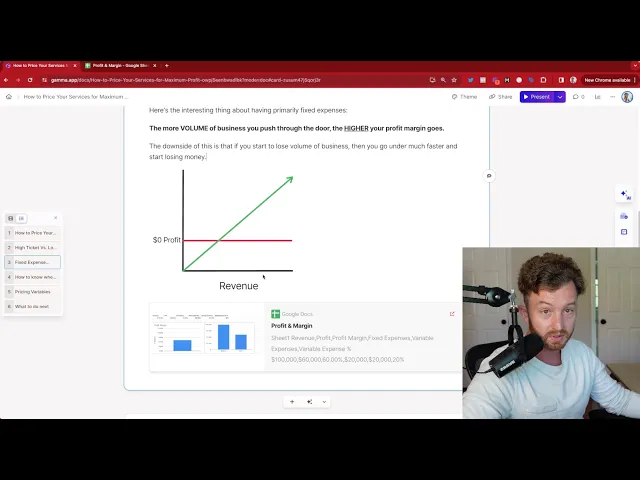
Here's why that matters: the more volume you push through, the higher your margin goes. It's an amplified effect.
Let me show you the math. Say your fixed expenses are $20,000/month with a 20% variable cost:
At $30,000 revenue → 13% profit margin ($4,000 profit)
At $40,000 revenue → margin more than doubles
At $100,000 revenue → 60% margin
At $200,000 revenue → 70% margin
Every additional customer you close generates more profit per customer than the last. The delta between your revenue and your fixed costs spreads at an increasingly faster rate as you scale. This is why pricing low enough to drive sales velocity is not a weakness — it's the entire game.
The 20–30% Close Rate Rule
Here's the simplest pricing diagnostic I know: you should be closing between 20% and 30% of your sales calls, consistently.
If you're below that range, you're almost certainly charging too much. If you're well above it, you might have room to raise prices — but you might also just be leaving money on the table by not spending more on marketing.
You know that feeling where every deal is an absolute grind? Where every prospect needs to see five more things, go through two more objection loops, and you're basically dragging them across the finish line? That's not a sales skill problem. That's a pricing problem.
There's no amount of sales technique in the world that creates money in someone's wallet that isn't there. If your prospect genuinely can't afford what you're selling, no amount of finesse changes that fact. Lower the price, close more deals, and move faster.
The Hidden Cost of Overpricing
Charging 20% more than the market wants to pay doesn't just hurt your close rate — it destroys your entire operation.
When prices are too high:
Sales cycles get 4x longer
Every deal takes 3x more work
Your fixed expenses keep burning the whole time
You get stressed, make bad decisions, and eventually quit
It's just not worth it. Lower the price 20%, close deals in a third of the time, realize the revenue four times faster, and actually enjoy running your business.
The Value Equation (And Why Case Studies Are Non-Negotiable)
Alex Hormozi's value equation is worth understanding here because it's just math:
Value = (Dream Outcome × Perceived Likelihood of Achievement) ÷ (Time Delay × Effort and Sacrifice)
To increase value, you need:
A bigger, clearer dream outcome (your headline claim)
Higher perceived likelihood of success (guarantees + case studies)
A shorter perceived time to results (case studies again)
Lower effort and sacrifice — which includes your price
Notice that price lives in the denominator. That means lowering your price by even 10–20% can disproportionately amplify your perceived value, which increases conversions. The math can easily work in your favor even if you're making less per deal — because you're closing far more of them.
Also worth noting: a strong case study does double duty. It increases the perceived likelihood of achievement and decreases the perceived time delay simultaneously. That's why building a library of case studies is one of the highest-leverage things you can do for sales.
Where to Set Your Margins by Revenue Stage
Here's a rough target framework based on where you are:
Under $50K/month → target 60–75% gross margin
$300K–$500K/month → 40–60% is healthy
Above 75% margin → you're either underinvesting in marketing or overpriced; get more aggressive
One Last Thing: Know Which Problem You Actually Have
If calls aren't closing, that's a pricing problem.
If you're not getting calls in the first place, that's an offer or traffic problem — and no pricing adjustment will fix it.
Know which variable is broken before you start pulling levers. And once you do know, don't treat your price as a fixed identity. You're not locked in. You can charge different prices to different prospects, test new structures, and adjust anytime you want. The market will tell you exactly what it's willing to pay — your only job is to listen.