
Marketing
How I Connect Paid Acquisition, Qualification and Calendar Capacity
· Updated
I connect advertising to the whole customer system: acquisition cost, value over time, qualification and the sales team's capacity. Cheaper calls are not necessarily better if the wrong people reach the calendar, and more spend is not useful if suitable people cannot find a time.
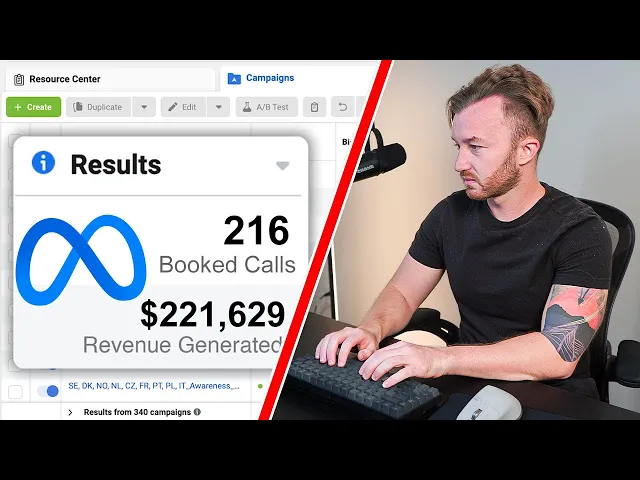
For the 30 days I opened the lesson with, I reported $1.161 million in revenue, $183,000 in ad spend and 766 qualified booked calls. I also mentioned 2,800 individual sales across offers, including self-checkout. Those sales were not all new clients closed on calls.
Look at the customers you already have
I use lifetime value, lifetime gross profit and acquisition cost to examine the business. Gross profit includes the direct cost of delivery; a payment arriving does not automatically mean that whole payment is profit.
Net revenue retention looks at the existing revenue base, excluding new customers. My example starts with 100 clients at $1,000 a month: losing ten clients removes $10,000 of monthly revenue, while upgrading ten others by $1,000 a month adds that amount back. That leaves the cohort's revenue unchanged before new acquisition.
Give an existing buyer a relevant next step
I described related offers serving different points in a customer's life cycle: a smaller entry purchase, a larger service, a cross-sell or something more suitable when the customer is about to leave. The purpose is to make the relationship useful for longer, rather than depend only on signing new people.
The initial offer may be designed to recover its acquisition spend quickly, with more value coming later. But even in the lesson I point out that matching a payment to acquisition spend can still leave delivery costs unpaid. The business needs the rest of the economics to work too.
Client Ascension related reading: Max’s ecommerce agency account discusses delivery pods and client retention.
Put qualification between interest and the calendar
The B2B flow I showed starts with a simple opt-in, then a VSL and an application before the calendar. The application checks business type, revenue, ability to pay and whether the market is large enough for that particular service.
If a setter is speaking with the lead, that person needs to perform the same qualification. In the system I described, the setter has to reveal the price, check the business revenue and confirm the person can afford the offer. Otherwise the closer receives a meeting that the form would have rejected.
Use the contact information you ask for
I generally used opt-ins because we followed up by email, phone and text. I also made the exception explicit: a more sophisticated, high-revenue market may respond better without an opt-in. That is something to test, not a reason to put a form in every funnel automatically.
My conversion event was the completed scheduled call after qualification, rather than the opt-in alone. That choice kept the event tied to the people who had passed the application and actually booked. It was the setup I described, not a guarantee about every advertising platform's behavior.
Treat calendar space as capacity
I call the range of convenient available slots availability variance. As a calendar fills, the remaining times may be less convenient for the next person. I had seen a new closer widen availability and lower cost per call without increasing ad spend.
In the planning example, a $300 qualified-call cost and five calls per closer per day means $1,500 of daily ad spend per closer. With five closers, that is $7,500 a day. It is a capacity calculation under those assumptions, not a recommended budget for someone else's company.
Test creative within the capacity you have
I described launching batches with the same body and different hooks, or a winning hook with different bodies. My preference was to spread spend across several ad sets instead of forcing everything through one. Those were my operating practices at the time, not a platform rule that can never change.
The sequence matters: make sure the sales calendar can handle more demand, then adjust spend and keep testing the ads. I would assess the acquisition result alongside what happens after the call and how customers stay, rather than optimize one metric in isolation.
Client Ascension related reading: the paid funnel guide explains historical lead-funnel and qualification mechanics.
Adapted by Client Ascension with AI assistance from Daniel Fazio's lesson. The first-person narrative follows the source speaker’s account. Watch the original video





