
Marketing & AI
How I Used AI to Draft a Launch Without Letting It Invent the Proof
· Updated
I used AI to draft the launch scripts, emails and funnel copy, but I still supplied the offer idea, examples and real proof. The most important correction was catching fabricated case studies and numbers, removing them and putting actual data in manually.
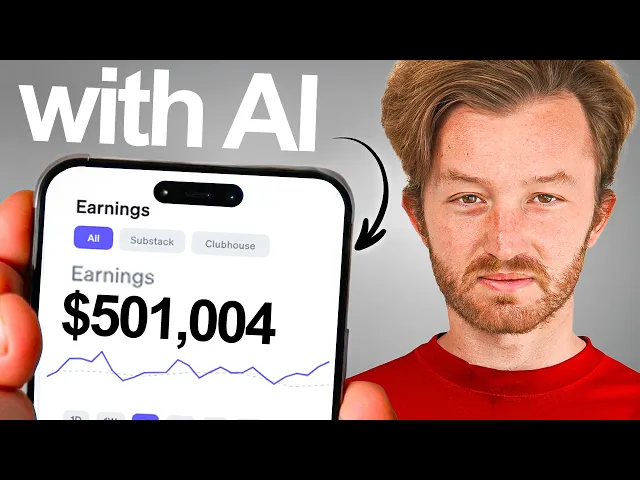
The launch I described used three YouTube videos and five emails to my list. I reported that it made over $500,000, and that I delayed the third video because of the volume of calls coming in. That was my launch account, not proof that AI alone produced the result or that another launch will perform the same way.
Start with your own offer and rough writing
I began with the idea for the AI-assisted agency offer and a rough email. I was using Manis in a long-running conversation that started on August 14, 2025. The useful starting material was what I wanted to sell and how I explained it, rather than asking for a complete launch with no context.
Then I asked what questions people would probably have about the model. The answers covered implementation, pricing, competition, execution and proof. I used those questions to guide more emails and supplied my own writing as the style reference.
Approve the series before writing every script
For the YouTube series, I asked for topics, titles, packaging and the purpose of each video before full scripts. The sequence was problem awareness, the mechanism and proof, then a blueprint that led into the offer. I wanted to see the plan before committing to all the copy.
I went back and forth on the drafts and their length. When the second script included fake examples and data, I told it to remove invented numbers and stories, then inserted my real figures myself. The fact that a draft sounds plausible is not enough to use it.
Client Ascension related reading: the AI workflow guide discusses collecting actual source material for email ideas.
Critique the sales page before rewriting it
I put the rough page copy into the conversation and asked for a critique aimed at getting people to book a call. Then I asked for a full rewrite using those recommendations and added the case studies it was allowed to use.
I made the proof boundary explicit: those agency owners had bought our general agency-growth offer, not the new AI-assisted agency program first. I told the AI not to invent stories about them. I also had it make a page mockup that I could give to a designer as a structural reference.
Design follow-up around the step someone has reached
For the opt-in sequence, I supplied the first email and asked for the strategy of the next messages before writing them in full. That kept the emails connected to the same offer, arguments and source material as the videos and page.
I also planned follow-up for someone who submitted an application but did not choose a call time. I asked for possible reasons, then used them to plan a pick-a-time email and later messages at three hours, 24 hours and 48 hours. Those reasons were hypotheses for the copy, not confirmed answers from every applicant.
Keep the production estimate in context
I estimated five to seven hours of total work on the scripts and funnel material. My comparison with how long it might have taken without AI was an estimate too. It was not a timed experiment showing that every marketer can produce the same launch in those hours.
The workflow still involved decisions about the offer, the argument, real examples, factual corrections, editing and the page structure. Those are the parts I would pay attention to when using this as a service workflow, rather than treat the model's first response as a finished client deliverable.
Assess the audience before packaging a service
When discussing a client offer, I would first look at the traffic they already had: an email list, CRM, YouTube, LinkedIn or another audience. The assets need to fit the route by which people will see them. If the client has no traffic, producing launch copy does not by itself create an audience.
I discussed performance-based arrangements and later improving terms as case studies build up. The concrete service is producing the marketing assets and learning what works for that client. It is not a promise that AI removes delivery risk or guarantees a financial result.
Client Ascension related reading: the organic content guide discusses connecting educational content with an owned audience and relevant offers.
Adapted by Client Ascension with AI assistance from Daniel Fazio's lesson. The first-person narrative follows the source speaker’s account. Watch the original video





