Business Growth
Offer Anchoring, Market Sophistication, and What Actually Grows an Agency
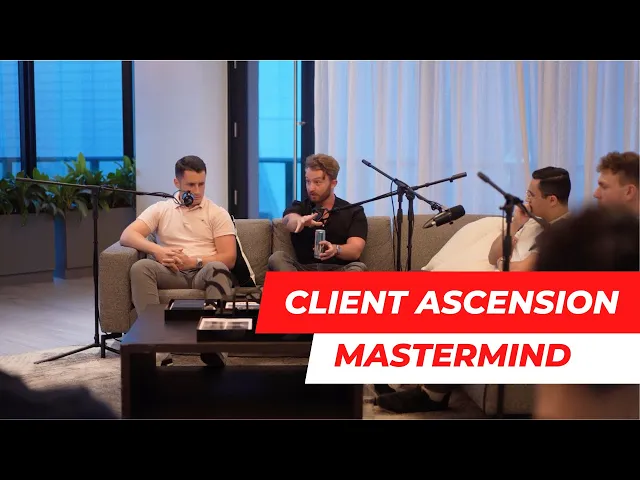
We flew 25 clients to Tampa for our mastermind and I want to share the most valuable things we covered — offer creation, market sophistication, sales storytelling, and the real reason most agencies plateau.
Offer Anchoring: Make It Tangible
The biggest trend I've seen in offer creation right now is anchoring. Most people think their offer sounds good. It doesn't — at least not to their audience.
Here's what I mean. If you say "I can be your fractional CFO," that's a job title, not a vision. But if you say "I scaled and exited a company using financial systems I now apply to businesses like yours" — now the prospect can visualize something real.
Same with fitness. "I can be your fitness coach" lands flat. "I'll help you lose 20 pounds in six weeks" lands because they can picture what that feels like.
The mistake I see constantly is vague ROI claims like "achieve a 4X ROAS with your campaigns." Nobody can visualize that. But "I helped XYZ brand generate $40K in three months and I can do the same for you" — that's concrete. That's anchored.
Our offer is: we'll help you build $10K to $50K a month in profit, or you don't pay. That's a claim. That's anchored to a specific, visualizable outcome.
Skip Straight to Market Sophistication Level Five
Markets sophisticate over time. A year ago you could pitch "I make short-form content" and it worked because the mechanism was novel. Now everyone's doing it, so the same pitch gets ignored.
People overthink this. They try to figure out which sophistication level their market is at — level two, three, four. My answer: stop guessing and go straight to level five every time.
Level five is simple: claim + risk reversal + evidence.
A strong claim tells them exactly what you deliver. A risk reversal removes their downside. Evidence proves it's real. That combination is instantly competitive at any level of market sophistication. You'll never be under-positioned using it.
The best part about evidence is that it compounds. Zero social proof to one case study feels slow. But one to ten accelerates. Ten to fifty is a landslide. The best-converting sales page I ever heard about was just an endless scroll of testimonials — claim, testimonial, claim, testimonial, repeat. People buy stories they can see themselves in, not bullet points.
Stories Are More Powerful Than Any Pitch
When you're 45 minutes into objection handling and a prospect still won't commit, the best thing you can say is: "You know who you remind me of?"
Then tell them the story of a past client with the exact same hesitation who took the leap and here's what happened. That's not manipulation — it's context. It lets the prospect see the other side of the decision.
I have our sales team watch client success story videos not to get hyped up that the offer works, but to memorize the details of the stories. The specific fears people had. The moment they decided to move forward. The exact outcome on the other side. Those details are what make a story land.
Product Is the Best Marketing
Word of mouth always sounds like a nice idea until you actually have it. Look at the room we filled in Tampa — almost entirely word of mouth. I didn't have to introduce myself to half the guys at the Default Kings event because our clients had already told them about us.
That comes from product. The best marketing is a product so good that customers become your sales team.
Building good product isn't complicated. Talk to your customers. One of our guys mentioned we didn't have a fitness channel in the community. I told him to open Slack the following week — we'd have one. That's how Zapier Concierge happened. That's how Bible study with Jennings happened. Someone asked, we found the best person who could deliver it, and we shipped it.
Why Most Agencies Stop Growing
Past a certain point — maybe $50K or $100K a month — the thing stopping you isn't cold email or offer positioning. It's that you haven't made the jump from freelancer to executive leader.
Most agency owners are transactional with their team. Here's your deliverable, here's your $30. That's not building anything. Real culture comes from three things: showing up yourself first, publicly praising your people, and actually caring about them as humans — not just outputs.
If your team won't fill out the end-of-day form, ask yourself: are you checking in with them every single day? If not, why would they? It starts with you.
The other false belief I see constantly: "No one can do this as well as me." That's the ceiling. They won't do it the same as you — but they can absolutely do it as well. And if they can't, that's a management problem, not a talent problem.
The One Thing I'd Start Earlier
YouTube. Without question.
Twitter works fast but doesn't compound hard. YouTube is slow to start but it indexes forever. A video I make today shows up in someone's recommendations three years from now. A tweet I posted last week is gone.
People need about ten hours of exposure to you before they trust you enough to buy. One YouTube video moves that needle more than a hundred tweets. If you want to be where the biggest people in this space are — they're either spending hundreds of thousands on ads or they're on YouTube. Pick one. I know which one I'd choose.
Show up. Stack inputs. Let go of the outcome. The results come — you just can't force the timing.