Agency Growth
Offer Formulation: How to Create an Offer That Clients Actually Buy
There are four things that make up a great offer. Get these right and you'll sign more clients than you know what to do with. Get them wrong and it doesn't matter how good your outreach is.
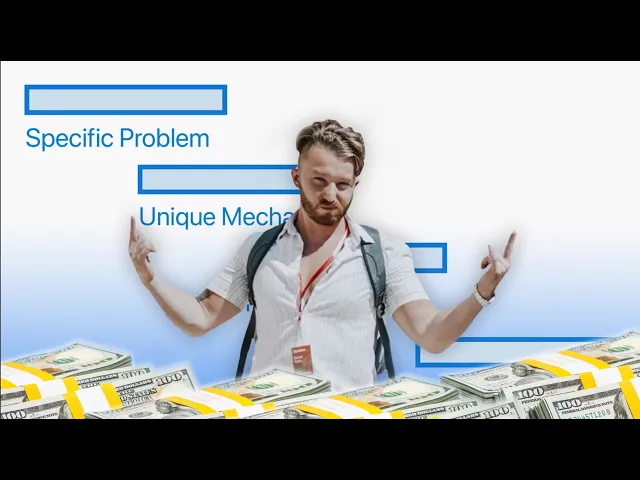
The four components — in descending order of importance — are:
Specific Problem
Unique Mechanism
Pricing & Terms
Risk Reversal
The higher up the list, the more it matters. If the problem you're solving is big enough, nothing else matters.
Specific Problem: Stop Making Things Up
Most people get this backwards. They pick a high-income skill — copywriting, Facebook ads, whatever — and try to work backwards to find a problem it solves. That's the wrong approach.
You have to start with the problem and work down. If you don't have a specific, real problem you're solving, you're building on sand.
So how do you find real problems? You go ask. Let's say your target niche is SaaS companies that just raised a seed round or Series A. Find them on email, Twitter, or LinkedIn and send something like this:
Hey [Name], I'm thinking about starting a service company and thought of SaaS companies as a niche. What problems do you guys actually have? I don't want to make something up — I want to solve a real problem.
That message will get replies. It's frank, it's human, and it treats the person on the other end like an actual person — not a name in a spreadsheet.
This is also a core principle behind cold email: the closer your message is to something that couldn't have been sent to anyone else, the higher your response rate. Individualization drives replies. Blast templates don't.
Unique Mechanism: Turn Your Skill Into a System
Having a skill is not enough. You need to package it into a repeatable system with a name and a clear process.
I had a client join recently — an email copywriter who wanted more clients. I asked him what made him great at email marketing. He explained that most info product owners burn their lists by pitching constantly. Cold traffic unsubscribes immediately. You have to play the long game and show personality.
His process: he gets on deep-dive interviews with clients, asks them questions like a therapist, essentially hypnotizes himself into becoming them, and writes emails that are completely indistinguishable from the client writing them themselves.
That's a unique mechanism. When I heard it, I was genuinely interested in working with him. That's the reaction you want.
He went from "email copywriter" — one of the hardest services to sell — to someone with a specific, compelling system. That's the transformation you need to make.
The formula is simple: high-income skill → unique named system.
Pricing & Terms: Charge Enough to Actually Scale
There are two types of offers: performative (you're promising a specific result) and productized (based on deliverables, results not directly dependent on you). Facebook ad agencies and cold email lead gen are performative. Video editing agencies and design agencies are productized.
Here's something most beginners get wrong about pricing: charging less doesn't always help you close deals — especially with sophisticated buyers. Larger companies associate low prices with low competence. If you don't charge enough, they assume you don't know what you're doing.
Unsophisticated buyers (small businesses): lower price = easier to close
Sophisticated buyers (larger companies): higher price = easier to close
If you're a beginner with no results, charging on a performance basis makes the most sense. It aligns your incentives with the client's, and honestly — if you're not confident in your results yet, you shouldn't be taking someone's money upfront anyway.
The Pricing Mistake That Kills Agencies
I heard this one on a Twitter Space: someone was charging $2,000/month for 60 short-form content pieces plus four long-form YouTube videos.
That's an unsustainable disaster. The margin is so thin, signing a second client becomes nearly impossible. You end up working constantly, making almost nothing, burning out, and eventually quitting — thinking you failed. But the real mistake was just not charging enough.
You need to charge enough that you can outsource labor, keep a ~60% margin, and still have cash flow to reinvest in the business. If you can't do that, you'll never scale past $10K–$20K/month.
For performative offers, aim to deliver around a 5x return on what you charge. For productized services, think about relative market rate + the premium your unique mechanism justifies.
Risk Reversal: An Amplifier, Not a Foundation
If you have a specific problem and a unique mechanism, risk reversal just amplifies what's already working. It's not the thing that makes an offer sell — it's the thing that pushes a good offer over the finish line.
If you don't have the first two, risk reversal is your entire pitch, and that's a fragile position to be in.
The most common forms, in order of sustainability:
You don't pay until it works (Performance-based)
You pay as it works (Pay-per-result)
If it doesn't work, you don't pay
If it doesn't work, we work with you until it does
For most people starting out, you're going to be at the top of that list. That's fine — just make sure you have enough runway to survive while you're building proof.
The Full Picture
When you have all four — a specific problem, a unique mechanism, smart pricing, and a risk reversal — you have a genuinely powerful offer. It's not just good, it's hard to say no to.
But it starts at the top. Find a real problem. Build a real system around solving it. Price it like you know what you're doing. Then use risk reversal to remove whatever friction is left.
That's the framework. Now go find some real problems to solve.