Agency Growth
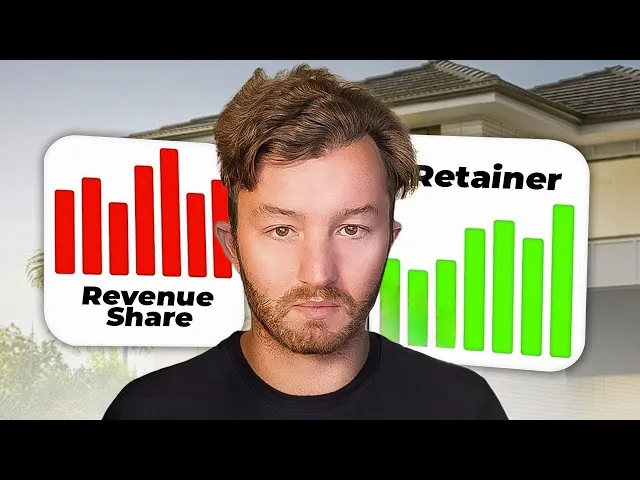
Retainers or Revenue Shares: Which Should You Actually Charge?
My name is Daniel Fazio. I make about half a million dollars per month running Client Ascension and co-owning List Kit. So when I talk about deal structures, I'm speaking from real experience—not theory.
The question I get constantly: should you charge a retainer or work on a performance basis like a revenue share? This debate matters because the wrong answer costs you serious money.
Let me break it down.
The Story That Explains Everything
Two days before filming this, I was on a coaching call with one of my students. He runs a lead generation agency. A commercial mortgage broker wanted to work with him—but here's the catch: the broker had been burned by agencies before and refused to pay anything upfront.
Instead, he proposed a 10% revenue share on closed deals. These are commercial loans, so we're talking $50,000 to $70,000 per loan. A 10% cut sounds like $5,000–$7,000 per deal. Sounds decent, right?
Wrong.
Here's what that deal actually looks like: my student pays for the domains, buys the lead lists, manages the cold email system, and does all the work—while the broker does nothing and waits to collect 90% of the deal. Oh, and these deals can take four to six months to close.
What I told my student to say was essentially this: What you're asking is for me to take all the risk—money and time—to run your entire marketing and lead generation system. If you want zero upfront risk, then I want 50%, not 10%.
That's the framing you need. If someone wants to take zero risk, you take half the deal. Period.
And the cardinal rule: never go negative on a performance deal. Don't spend $1,000 of your own money buying leads and accounts for a client you don't control. You don't control their product. You don't control their sales team. Don't do it.
The Real Reason Marketing Gets Paid So Much
Here's something most people miss: 80% of running a company is finding customers. That's it. The actual deliverable—the product or service—is the easy part. That's why salespeople and marketers are the highest-paid people in any organization. They are the business.
When that mortgage broker said he'd give my student a 10% clip, he was essentially saying: You do the most important part of my business, take all the financial risk, and I'll give you a small cut. That's not a deal. That's exploitation.
How to Identify a Business Worth Doing Revenue Share With
Here's the counterintuitive truth: if a business is eager to offer you a revenue share, that's a red flag.
Winners are confident they'll keep winning. They don't want to give you an uncapped upside when they know everything they touch turns to gold. That's exactly why Client Ascension—my company—will never offer a revenue share to a vendor. We have optimized funnels, a world-class sales team, a hundred-plus case studies, and high LTV customers. Whatever we do with a service provider is probably going to work. I'm not giving away the upside on that.
Losers, on the other hand, don't want to pay upfront because they're operating from scarcity. They're secretly convinced they'll fail—and they usually do.
So the businesses most willing to do performance deals are the ones least worth doing them with.
The Two-Sided Equation
Getting a great performance deal requires two things:
Finding a high-quality business — one that actually performs and makes real money
Being world-class yourself — because elite businesses only work with elite people
Take Alex Hormozi. If he came to me and wanted a revenue share arrangement, I'd take it in a heartbeat. His authority and track record are undeniable. But a random video editing agency asking me for a revenue share? Absolutely not.
Authority is built through two things: case studies and content. That's it. Build a body of proof and a body of work online, and the caliber of client you can attract changes dramatically.
The Timeline Every Agency Owner Should Know
Here's how this actually plays out in real life:
Phase 1 — Your first 10 to 15 clients: You'll almost certainly be doing performance deals because that's all you can get without case studies. You also have no choice but to sign some bad businesses. That's just reality. The Pareto principle applies here: 80% of your clients will run mediocre businesses, and only about 2 out of 10 will produce a real case study.
The lesson? Don't stop at two or three clients thinking you'll nail results for all of them. Sprint to 10. You need volume to find the 20% that actually work.
Phase 2 — After you have authority: Once you have quantifiable case studies and you've been consistently creating content, you can shift to upfront payments and retainers—potentially with a small performance kicker. This is where most solid agencies live, and there's nothing wrong with staying here if it's working.
Phase 3 — If you're truly world-class: You can loop back to performance deals—but only now, because the businesses worth doing them with will finally take you seriously. We're talking 10%, 15%, even 20% revenue shares with high-quality companies. But this only works if you can genuinely make those companies serious money.
The Bottom Line
Here's the quick recap:
Don't let people screw you. Recognize unfair deals and walk away from them.
Your value is what the market pays you—not what you list on a checkout page no one ever buys.
Do performance deals in the beginning because that's what you can get.
Do performance deals at the end because that's when the right businesses will finally agree to them.
Everything in the middle is retainers—and that's perfectly fine. Build the authority. Get the case studies. Create the content. The deal structures you can command will follow.