
Business Growth
My Agency Growth Sequence: Skills, Evidence, Offers and Hiring
· Updated
I would build an agency by learning a useful business skill, getting client evidence, turning the service into an offer and developing acquisition before handing more of the work to a team. The sequence matters because hiring and paid traffic need something that already works to build on.
I presented the source plan around a $100,000 monthly target over 24 months, but said my own first month at that level took about two and a half years and was abnormal. This is a proposed sequence with changing constraints, not a forecast that a beginner reaches the number on schedule.
The service skill can sit in different parts of a business
I grouped skills into traffic generation, traffic conversion and back-end operations. Traffic work brings attention or prospects; conversion work helps turn existing attention into customers; operations ties together work such as automation, finance, recruitment and support.
Those are different kinds of value, not identical sales propositions. I argued that new-traffic work can be easier to sell initially, while conversion and back-end work can support longer relationships. That was my broad framework, not a measured retention rate for every service.
My recommendation was to become capable enough to execute the work, without waiting until I felt like a complete expert. Studying is part of it, but eventually the competence has to be tested by doing the work for a client.
Early work has to produce proof, not only a payment
I recommended free or performance-based early work to make the first engagements easier to accept when there is little evidence. The point was to get real client results and case studies, rather than assume a new prospect would trust a large upfront price without proof.
I described doing free work myself before getting that evidence. The structure of an early offer is not proof that all client risk disappears or that a beginner can guarantee a return. Delivery still has to work.
Client Ascension related reading: the asymmetric offer article explains how I think about service economics and positioning. It is another framework to consider alongside the actual evidence behind an offer.
A direct-response offer explains the outcome and its conditions
The offer components I described were the result, the time period, what happens if the result is not delivered and evidence of previous work. The proposal needs to explain what the buyer gets, rather than only list how many production hours or deliverables the agency supplies.
The numerical promises in the video were offer examples. They were not measured outcomes every agency could copy into its own guarantee. An offer needs an actual ability to deliver and terms the buyer can understand.
Outreach can start from different kinds of entry offers
I described a service-based lead magnet, a useful resource or case study, a small low-commitment offer and a direct pitch. Those are different ways to open a conversation. I would keep the message short and make the offer clear rather than hide the fact that I was approaching the business.
The sending volumes and tools in the source were part of a historical plan. They were not a verified deliverability benchmark or evidence that a fixed volume always turns into clients. I would judge the process by the work actually moving through it.
Client Ascension related reading: the acquisition guide discusses channel fit and cost per client over a full sales cycle. It gives context for judging outreach beyond message volume.
Build assets while the outreach is happening
I wanted a clear video explaining the offer, useful tutorials, active professional profiles and continuing case-study production alongside outreach. An interested buyer then has something to examine instead of only a cold message.
For a tutorial, my example was a screen-share showing how to use the software involved in the service. It did not need elaborate editing. For a case study, I wanted a real client, their business and the specific result identified, rather than an anonymous success claim.
I would hire from delivery backward toward acquisition
The business has marketing, sales and fulfillment, but I recommended hiring in the reverse order: fulfillment first, then sales and later marketing. Before hiring, the founder needs enough understanding of the work to explain and train it.
I suggested beginning with repetitive work rather than expecting the first hire to take over everything. Training can increase the founder's workload before it reduces it. Once time is freed up, the plan was to put it back into the activities that support the next stage.
Client Ascension related reading: Nick's email agency case study describes a specific operator's hiring and shared delivery system. It is an example of operating work, not a guarantee that every agency follows the same hiring timetable.
Paid traffic needs a delivery and sales system behind it
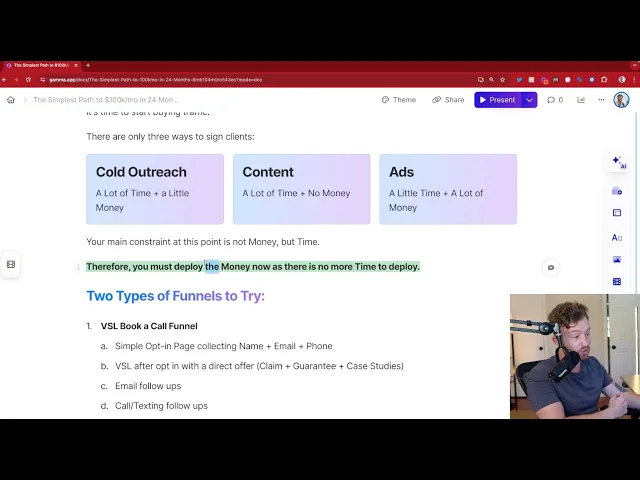
I introduced paid acquisition after the business had money available, a functioning sales process and delivery producing results. The example funnel was an opt-in, an offer video and a way to book a call, with follow-up for people who did not book.
Those were proposed conditions for deploying cash, not verified financial thresholds that force a business to start advertising. Spending on traffic adds leads to a process; it does not independently fix the offer, sales or delivery.
A paid entry product has to attract the right future service buyer
I treated a self-liquidating funnel as a later, more complex option after the simpler call funnel. Its entry offer tries to bring sales revenue back against acquisition spend, while the service relationship creates the possible later value.
The entry product needs to be relevant to the eventual customer. I used editing as an example: teaching somebody how to make money as an editor attracts a different buyer from somebody who wants to purchase editing services. The entry offer and the service cannot be assumed to fit just because they share a topic.
Client Ascension related reading: the AI Assisted Agency program page has current offer details. Historical tools, training products and prices mentioned in the source plan are not current terms here.
Adapted by Client Ascension with AI assistance from Daniel Fazio's lesson. The first-person narrative follows the source speaker’s account. Watch the original video





