
Business & Entrepreneurship
The Sales and Operating Lessons I Took From Building Client Ascension
· Updated
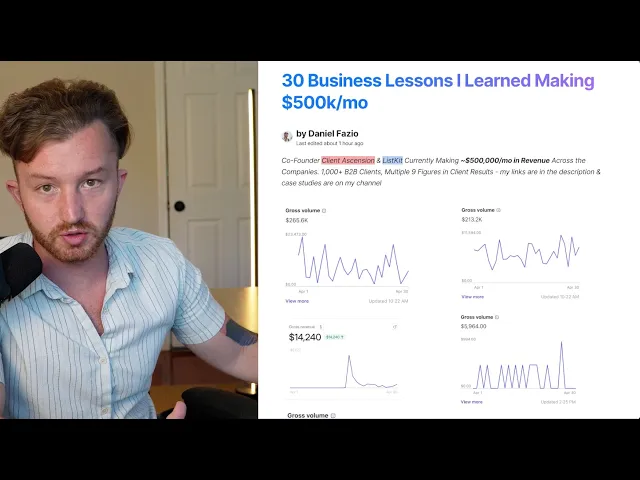
I put getting prospects onto calls, delivering a result they can see and building proof near the center of running a service business. Those were recurring themes in the lessons I shared while Client Ascension and ListKit were making roughly $500,000 a month in revenue in the period I discussed in 2024.
The useful question is which part of the business is actually holding you back. A problem that looks like a weak offer may instead be an irrelevant lead list, too little traffic or a reluctance to follow up. I would diagnose that before building a more elaborate system.
Do not confuse getting a call with closing it
I contrasted an estimated close rate of around 20% on calls with cold email producing perhaps one to four calls per thousand emails. Those numbers describe different steps and different denominators. The lesson I was making was that getting the right person onto the call can be the harder bottleneck.
I also argued that a buyer who values time highly may be easier to persuade to pay than to spend time on a call. That is why I would explain what work the service takes off their plate, instead of assuming that a higher fee is always the main obstacle.
Look beneath the first explanation of the problem
I had seen owners describe a lead-generation problem when they were not following up with replies because they were uncomfortable with sales calls. I had also felt the fear of taking money and then having to deliver. The practical task is to identify that hesitation rather than keep changing the offer around it.
Similarly, a cold email can fail because it reaches the wrong kind of buyer. Rewriting the script does not solve an irrelevant list. Before deciding an offer is broken, I would check who had actually seen it and what outreach or content had gone out.
Client Ascension related reading: the organic content guide discusses connecting educational content with an owned audience and relevant offers.
Make client results a skill you keep improving
I would not build the business only around learning to acquire clients. I argued that getting better results for them supports staying power, pricing and future case studies. That requires understanding the work, not assuming a large markup over a cheap white-label service will take care of the result.
If I had to keep one marketing activity, I said I would keep creating and collecting case studies. I value them because another prospect can see what happened for a previous client. That is my strategic preference, rather than a measured claim that social proof beats every other marketing variable in every market.
Build visible competence and connect the channels
An active YouTube presence gives an interested prospect something to find when they search your name. In the lesson, I encouraged starting that body of work before expecting it to be large. The useful asset is evidence that you exist and know the work, rather than a promise of a fixed increase in conversions.
I used a hypothetical journey to explain how channels can reinforce each other: a cold email leads to a search, then a site visit, content or retargeting. The point was to build connected touchpoints, not to claim that one isolated message accounts for every sale.
Keep the system simpler than the problem
I warned against building a complicated automation stack without knowing whether it improves sales. I would measure the return on what I pay for, use a tool deliberately or cancel it, and keep the system focused on the work the business actually needs.
I also distinguish a broad market from a segment that is too narrow. A business can misdiagnose weak lead generation as saturation, but a tightly restricted niche can genuinely limit its reachable market. Those need different responses; changing the niche is not the answer to every stalled campaign.
Treat observations as things to test
I described patterns I had seen in coaching when owners increased their outreach, content or advertising activity. I would use that as a reason to examine the amount of work going into acquisition, not as mathematical proof that every increase in volume guarantees a client.
The lessons also included how I had spent money on education and thought about hiring more experienced people. I would keep the underlying question concrete: what skill or operating gap am I trying to close? A revenue threshold by itself does not make a particular purchase the right decision for everyone.
Client Ascension related reading: the take-home income lesson distinguishes a larger revenue headline from owner income.
Adapted by Client Ascension with AI assistance from Daniel Fazio's lesson. The first-person narrative follows the source speaker’s account. Watch the original video





