
Business Growth
How I Connect Solution-Focused Content, Case Evidence and Referrals
· Updated
The system I describe has three jobs: create more opportunities, help appropriate prospects evaluate the offer and let client work produce material or relationships that support the next sale. I want those jobs connected rather than treat publishing, sales calls and delivery as unrelated activities.
Make content for a buyer seeking a solution
I distinguish entertainment from material a business owner searches for when trying to solve a problem. Relevant formats include software explanations, case studies, how-to guides, comparisons and interviews.
In the lesson, I use keyword questions about email marketing as an example of finding specific subjects to answer. The action is to make a useful video addressing the question, not assume a broad business title will reach the intended buyer.
Client Ascension related reading: the B2B content ideas guide develops another way to connect the service and target customer with useful topics.
Reuse the work in formats the audience can find
After making the video, I suggest turning its substance into a written thread or post for other professional channels. The underlying explanation already exists, so it can be presented in another format.
I also use material requested in sales conversations as content: work samples, case evidence, expected-result explanations and walkthroughs of what happens after purchase. Published clearly, those assets can help both a current prospect and somebody discovering the business for the first time.
Make the offer and its evidence inspectable
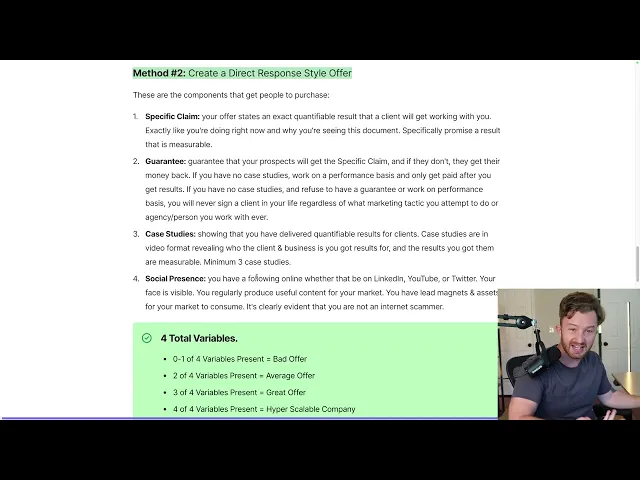
I describe the sales proposition through a specific result, a risk-reduction arrangement, case evidence and a recognizable public presence. These give the prospective buyer different ways to evaluate the provider.
For a beginner without case evidence, I emphasize doing work that can create proof rather than inventing a track record. The arrangement must still match what the agency can genuinely deliver.
Client Ascension related reading: the value proposition guide examines what the buyer wants and how the agency explains the bridge to it.
Document the actual client and the period of the result
For a case-study interview, I want the audience to know who the client is, what happened and the time frame. I explicitly reject fabricating testimonials.
The operating sequence is to sign a client, do the work, document the supported result and make the case available to appropriate future prospects. That turns delivery into evidence rather than leaving the next sales conversation with only another claim.
Client Ascension related reading: Areeb's content agency case study is a separate example of an operator account with a defined service and business context.
Compare a referral fee with acquisition cost
My hypothetical outreach model includes $350 for data, $400 for sending accounts and software, and 15 hours of work valued at $200 an hour to acquire a client. That is $750 of direct spending and $3,000 of modeled labor cost.
Against that illustration, I ask whether paying $1,000 for a client referral could make sense. It is a comparison of assumed acquisition costs, not evidence that every referral has that value or that the same costs apply to another agency.
Define what counts as a new referral
In the example, I require the referral to arrive through a specific booking route and to be someone not already in the funnel. Otherwise a referral fee could be claimed for an opportunity the business already had.
The larger point is to connect acquisition with the evidence and relationships produced by serving clients. Content, work samples, case interviews and a clear referral process can support different stages of that system.
Adapted by Client Ascension with AI assistance from Daniel Fazio's lesson. The first-person narrative follows the source speaker’s account. Watch the original video





