Business Growth
How to Charge More Money and Still Sign Clients (Even More of Them)
I'm Daniel Fazio, co-founder of Client Ascension. We're doing around $500K per month with over 1,000 B2B clients. I've seen what separates agencies that grow fast from ones that stay stuck — and a huge part of it is pricing.
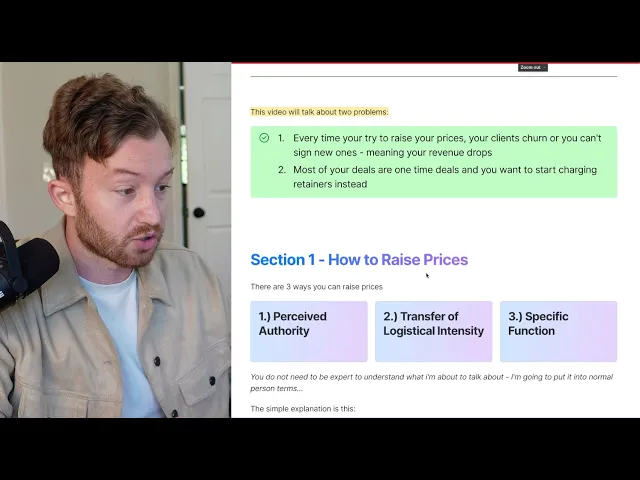
This is for marketing agencies, B2B companies, and freelancers who want to charge more without watching deals fall apart. There are two problems I want to solve here:
Every time you raise prices, clients churn or new deals dry up.
All your work is one-time projects and you want retainers.
Let's get into it.
Section 1: How to Raise Your Prices
There are three mechanisms by which you can charge more. None of them require you to be world-class at what you do — they require you to position yourself correctly.
1. Perceived Authority
Spending money is scary. Nobody enjoys it. And since every single person you're selling to is a human being with human emotions, they need to feel safe before they hand you money. That safety comes from looking up to you.
Authority comes from two places:
Content. YouTube, LinkedIn, X — you need to be everywhere. If you're selling any form of marketing or B2B service in this market, having an active content presence is not optional. It's non-negotiable. You have to exist on the internet in a real way.
Case studies and testimonials. Have you helped someone like them before? How many people have you gotten results for? What do clients say about you? People are going to investigate this. Social proof is the single largest indicator of what's safe to do — show them that other humans already trust you.
If you don't have a big client base yet, referrals won't carry you. That's why content becomes even more critical early on. It does the authority-building that word-of-mouth can't do yet.
2. Transfer of Logistical Intensity
This one is simple: do more stuff that other people don't do.
Imagine two roofing marketing agencies. Agency One runs ads and sends leads to the client. Agency Two runs ads, qualifies the leads with a human call, and confirms each prospect is financially ready to buy. Almost nobody does that second part — and that's exactly why it commands a premium.
Qualifying leads takes real manual labor. It's a pain. You don't want to do it, your competitors don't want to do it, and your clients don't want to do it either. That means the supply of people willing to do it is low. When supply is low, you can charge substantially more than it costs to execute — which is literally the definition of a profitable business.
Here's a clearer example. Agency Owner One offers:
Funnel build and design
Automation setup
Copywriting
Agency Owner Two offers all of that, plus:
Ad scripting and editing
VSL copywriting and editing
Email flows
Media buying
Conversion rate optimization
Weekly split tests
Who would you pay more for? It's obvious. And here's the bonus: Agency Owner Two doesn't just elevate themselves — they implicitly expose everything Agency Owner One isn't doing. That's a double amplification. You go up, your competitor goes down.
3. Specific Function
Who you sell to and what your service does for them determines how much they'll pay.
Say you run a content marketing agency that does scripting and editing. Who pays more:
A guy running a podcast who wants social clips for more views?
A DTC e-commerce brand pushing six figures per month in ad spend who needs product video ads?
Clearly the DTC brand. The specific function of your service — and whether it maps directly to revenue for the buyer — is a massive pricing lever.
If you're under 30 building an agency, this is also just good career advice. The network you build and the clients you serve become your career trajectory. Attach yourself to industries with serious money flowing through them. Become the go-to person for a high-value use case. That's the move.
Section 2: How to Turn One-Time Projects Into Recurring Revenue
I got a question from someone doing website builds who wanted to add a monthly recurring component. Here's the answer:
Recurring services require recurring work. Something new has to happen every month. A new deliverable, a new project, a new initiative — that's what justifies a monthly retainer.
If you run a YouTube editing agency and clients keep churning, it's usually not because your work is bad. It's because they stop doing content altogether — they get busy, they get lazy. Two fixes:
Script the videos for them. Make it easier for them to stay consistent. This also transfers more logistical intensity to you, which increases your value and your price.
Work with higher-quality clients who take their business seriously and don't quit when things get hard. Getting access to those clients is a perceived authority problem — which brings us full circle.
Here's how the web design agency can restructure its offer. Instead of: "I'll build you a conversion-optimized landing page."
Try: "Every month, I'll build a new conversion-optimized funnel with a fresh lead magnet. I'll run weekly split tests on everything we've built, create static ad creatives to drive traffic, and build out the backend email automations for every lead that comes through."
That's a recurring service. That's serious logistical intensity. And that commands serious money.
The Formula
To charge more and keep clients longer, you need to do three things:
Add more deliverables to justify monthly billing (transfer of logistical intensity)
Work with better clients who stay in business and take it seriously (perceived authority gets you in the door)
Tie your service directly to revenue or profit for the client (specific function)
That's it. Stack all three and your prices go up, your churn goes down, and your business actually grows.