AI Business
The Business Model Y Combinator Is Betting Billions On (And How to Get In Now)
Y Combinator is the most successful startup incubator in the world. They were the first investors in Airbnb, Dropbox, Reddit, Stripe, and Coinbase. So when they announce they're looking to deploy billions into one specific type of company, that's one of the strongest signals of where the world is going.
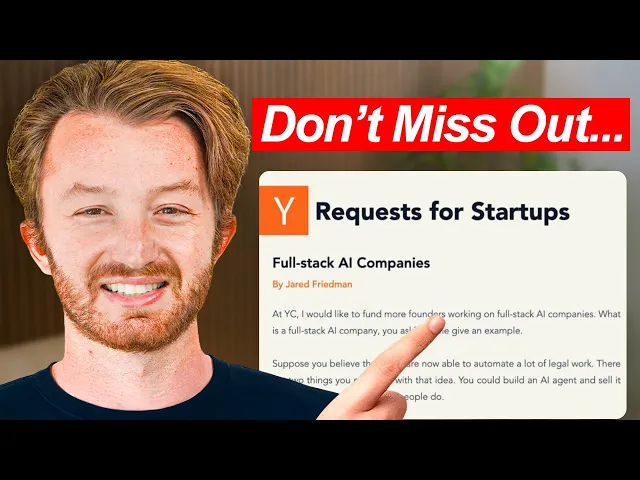
A few weeks ago, they made exactly that announcement. The category they're backing is something they're calling a full stack AI company.
What Is a Full Stack AI Company?
Here's the exact framing from YC's post:
Suppose you believe that LLMs can now automate a lot of legal work. You could build an AI agent and sell it to law firms — that's what most people do. Or you could start your own law firm, staff it with AI agents, and compete with existing law firms. That's going full stack.
Instead of selling tools to the incumbents, you become the competitor. Instead of selling to the dinosaurs, you make them extinct.
That idea hit me hard when I first read it, because it's exactly what I've been doing — just without the label.
Why This Is the Biggest Opportunity Since the Internet
For all of history, the constraint of scaling a service business has been talent. Talent was the deliverable. You needed people who could write emails, build ads, craft sales pages. Those people don't just appear — you have to find them, hire them, and pay them six figures a year.
That constraint no longer exists.
AI has infinite scale. You can now execute the deliverable work for ten times as many clients with just yourself as the only employee. The cost of fulfillment has essentially collapsed.
That's not a small shift. That's a structural change in how service businesses work — and the window to get in early is open right now.
You Don't Need to Build AI. You Need to Use It.
I'm not a programmer. I can't code. And none of what I'm about to share requires you to understand machine learning or have a computer science degree.
Thinking you need to build AI to profit from it is like thinking you need to build a power plant to use electricity. You don't. You flip a switch.
AI is the new electricity. The people who get rich from it over the next 5 to 10 years are the ones who figure out how to apply it to existing problems — not the ones who engineer the underlying models.
The Best Business Model for This Moment: AI Marketing Agency
YC's law firm example is compelling, but I wouldn't start a law firm unless I were a lawyer. Most people shouldn't. The better question is: what's a full stack AI business that doesn't require specialized credentials?
The answer is a marketing agency.
At its core, a marketing agency helps businesses get traffic on the internet. That means writing ads, creating social media content, scripting and editing videos, building email sequences. Every single one of those deliverables is text-based, delivered entirely online.
And 100% of them can be automated with AI.
This is different from running a law firm or an accounting practice. There's no courtroom, no licensed professional requirement, no physical logistics. The deliverable is content — and AI is extraordinarily good at producing content.
What This Looks Like in Practice
When I started my first marketing agency years ago, I did everything manually. I personally wrote all the copy, built the pages, compiled lead lists, handled follow-ups.
Now I have AI agents doing the work of roughly five full-time employees:
An AI that writes my video scripts
An AI that structures my landing pages
An AI that writes my ads
An AI that builds full sales pages and email sequences
These agents work 24/7, never get tired, and cost me less than $300 a month to run.
That's a full stack AI company. I took what I was already doing, plugged AI into it, and made the business ten times more efficient. You sell that efficiency as a service to other businesses.
I'm the co-founder of a software company called Liskit, which raised at a $48.6 million valuation, and a consulting company called Client Ascension where we help people build AI businesses. We're doing roughly $15 million a year in revenue. I'm 28. I started at 19. None of it required a technical background — it required finding the right leverage.
The One Thing That Stops Most People
Here's where 99% of people get stuck: they see the opportunity, but they get overwhelmed by the options. Should you serve real estate agents or e-commerce brands? Should you sell content, lead generation, or funnel building?
They spend weeks in analysis paralysis and never actually start.
The answer is to pick something specific, execute it with AI doing the heavy lifting, and iterate from there. The barrier to starting has never been lower. The cost of not starting has never been higher.
The Shift Is Happening Now
YC doesn't throw billions at trends that are years away. They back what's working now and fund the people moving early.
Full stack AI companies are the next wave of business formation — not because it's a clever idea, but because the economics finally make it possible. The cost of fulfillment is near zero. The tools are accessible to anyone. The incumbents are slow.
The question isn't whether this opportunity is real. The question is whether you're going to be one of the people who moves on it.