
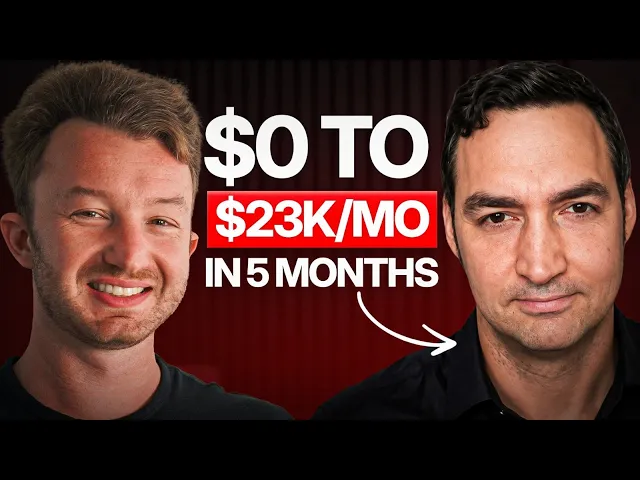
How I Built an AI-Assisted Agency to More Than $23K MRR
I'm Nick. At the interview, I reported more than $23,000 in monthly recurring revenue after signing another deal, and $25,000 in cash collected the previous month. Those are different measures, and neither is a profit figure.
I was running the business without employees, using AI to help prepare outreach and deliver sales assets. The change was choosing an offer, getting it in front of prospects and learning through actual client work instead of trying to think through every possible objection first.
I had to choose an offer and start putting it to work
I came from e-commerce work and had experience with analytics and Google Tag Manager. The initial offer I brought to an offer call was rejected as unsuitable for cold traffic. I spent time reconsidering services before choosing ads and funnels.
I described myself as a chronic overthinker. I needed to get clients and put the theory into practice. Knowing more in advance did not replace learning how to fulfill the work for someone paying me.
Client Ascension related reading: the first-client article develops the idea of making a concrete offer before you have a library of case studies.
The first deal was a package of work, not an AI pitch
My first client came from cold outreach and ran an established information and coaching business. What interested her was seeing the deliverables I would take on. The initial agreement was an $8,000 setup fee plus $5,000 monthly; later, we moved to a revenue-share arrangement whose terms I did not disclose.
I did not have a case study for that first sale. I explained the work and made the responsibility I would take off her plate concrete. I was still working with her at the interview, but I did not provide a measured client return or a retention rate.
I used prepared work to make outreach tangible
My outreach used a personalized document with work prepared for the prospect. I kept using the same basic strategy after the first client, with more confidence and an example I could include. I used email and LinkedIn, and LinkedIn was where I said I was getting traction.
The preparation flow researched the prospect’s website, brand, product and positioning, then used that research to build offers and deliverables in an interactive document. I said the early AI output was imperfect and improved as I got better at using the tools.
Client Ascension related reading: the acquisition guide covers how outreach, offers and sales fit together. It does not turn my experience into a measured conversion benchmark.
I sold implementation across the funnel
My service included ad scripts, funnels, email flows, CRM automation and arranging video editing. Clients recorded video and I got it edited. I also worked on VSLs, landing pages, breakout videos and additional offers when those assets were needed.
I did not see much value in handing over email flows the client could not implement. The implementation was part of the stack, although my first client already had much of the underlying structure in place.
AI helped me iterate, but the results were my own account
I used code to build landing pages and could iterate quickly. When a client asked why I was not using the page builder, I explained that approach and said we could rebuild a proven version in the builder later.
At the interview, it was just me running the agency. That did not mean the business had no software costs or that revenue was all take-home income. We did not establish a profit margin or a precise elapsed growth timeline.
Client Ascension related reading: the AI Assisted Agency program page contains current details. My interview describes a personal experience, not a promise of similar revenue or a statement of current software pricing.
Adapted by Client Ascension with AI assistance from Nick's interview. The first-person narrative follows the source speaker’s account. Watch the original video





