
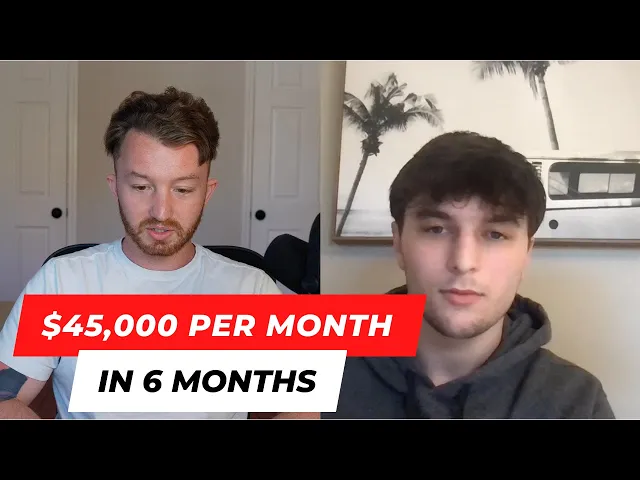
How I Grew My Cold Email Agency From $10K to Around $45K a Month
I'm Jake. At the time of my interview with Daniel, I reported roughly $40K–$45K a month from a cold email lead generation agency. About six months earlier, when I joined Client Ascension, I was working alone at around $10K a month. Those are reported business figures; I did not give a profit figure.
My explanation for the change was more outreach volume supported by a team, rather than finding a completely different offer. Hiring, tracking the work and collecting proof from clients became part of how I ran the agency.
The service stayed straightforward
My agency serves B2B companies, with financial services my main focus at the interview. The service is cold email lead generation: clients pay us to help them find customers.
I described retainer arrangements as well as performance-based work. When I first joined, performance campaigns accounted for my revenue apart from signup fees. That made getting campaigns to work important to the business; the interview did not establish a standard fee or margin to copy.
Related reading selected by Client Ascension: Oleg's cold email agency case study describes a different operator's business. It is a comparison, not evidence of Jake's results.
More activity needed more delivery capacity
Cold calling every day was how I got started. It was difficult work, but I kept doing it.
When I described the move beyond that stage, I kept coming back to volume. My point was that you cannot keep increasing activity without people behind you to handle the work. The team and the volume had to go together.
That was my explanation of my own business, rather than proof that doubling outreach will double another agency's revenue. The conversation did not isolate the contribution of each change.
Hiring needed a way to judge the work
Before Client Ascension, I did not have a team and did not know much about tracking a hire's performance. I learned that I needed a system and KPIs, rather than simply hiring someone and hoping it worked.
At the interview, I had three people working with me and also used contractors. I did not describe all their roles or employment terms, so the useful lesson is the capacity I was building, not a staffing plan for every agency.
Client interviews gave prospects something to inspect
Before I had client interviews, prospects would get on calls and ask for references. After I started collecting those interviews, I said that request stopped coming up for me. The proof was there for people to see.
That is an experience from my sales conversations, not a promise that publishing a case study will remove every objection. What changed was that I could show client accounts instead of only explaining the service.
I asked for help on campaigns that were not working
When a client's campaign was struggling, I asked questions in the community. I wanted to know which industries were working and how to improve the campaigns I was running. That mattered when I was being paid on performance terms.
I thought it was Nick who gave me advice on industries to target. I also noticed people asking the same industry question over and over on calls.
Confidence helped me keep doing the work
I do not fully know where my blind confidence came from. I said that being around people already operating at a higher level helped me believe I could build the business too.
The practical changes in my account were still concrete: doing the outreach, adding people to support it, tracking hires, collecting client proof and getting help with delivery. The reported monthly figure does not tell you the costs, profit or outcome another operator should expect.
Adapted by Client Ascension with AI assistance from Jake's interview. The first-person narrative follows the source speaker’s account. Watch the original video





