
How I Structured Our Amazon Coaching Business for Growth
I'm Michael. Ryan and I run an Amazon FBA coaching and education business. We had experience selling and mentoring, but we needed to turn scattered one-to-one help into a program that could support more students without losing the personal attention.
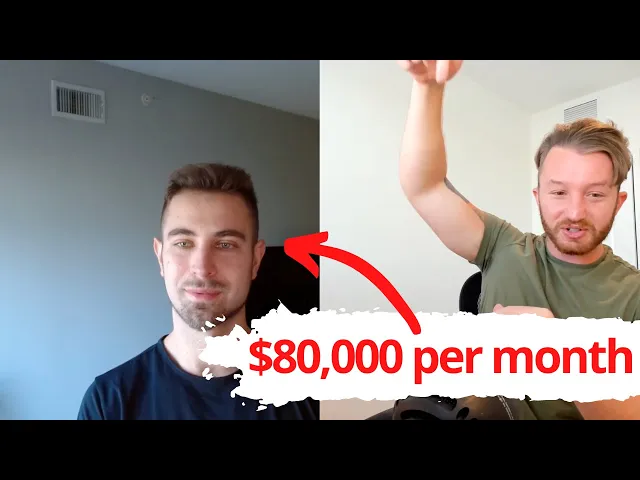
I said the coaching business was doing roughly $20,000–$25,000 a month when we joined Client Ascension around June. In our December interview, I reported a peak above $80,000 in October, followed by around $65,000 in November. Those were reported monthly business figures, not a stable recurring run rate or a profit figure.
We had expertise before we had a clear program
My background was corporate accounting, and I had built an Amazon private-label brand before partnering with Ryan. People were already asking us for mentorship because they saw us discussing our own experience online. We had courses and direct mentoring, but the offer and the program needed to be refined.
The coaching covered the work of building an Amazon brand: finding and sourcing products, creating listings, pictures and videos, then scaling. We were not starting with the question of which business to choose. We wanted help putting an existing business together more effectively.
Client Ascension related reading: Collin's consulting case study explains adding consulting for in-house teams alongside agency services. It is a comparison of delivery models, not another result from our Amazon program.
The group structure did not remove one-to-one support
We were thinking about a group program when we joined, but we still offered one-to-one coaching. Ryan and I made our call links available. The aim was to build a more organized program around the students, rather than simply replace access to us with a group call.
That balance mattered as we grew: we wanted people to keep getting the hands-on support they expected. Refining the system while preserving that experience was an ongoing operating problem, not something solved just by enrolling more people.
Onboarding gave the service a sequence
Before the operating work, we had the information but were answering one-off questions inefficiently. I described being scattered solopreneurs. Once the program had a clearer sequence, we knew a new student would go through onboarding, enter the system and book a call.
That structure made it easier for us to sell with conviction because we knew what would happen after someone paid. The student's product launch and business outcome still depended on the work ahead; an organized onboarding process was not a guarantee of an Amazon income result.
A closer freed us to work on content and the program
We had hired a closer and were no longer taking our own sales calls. I said that freed us to focus on higher-quality content and running the program. Building a more robust sales process was still a next step.
The discussion also covered possibly adding setters, more closers and operations support. Those were future needs being discussed, not a description of a completed sales and management team at the interview.
Client Ascension related reading: the acquisition guide connects marketing with the sales process. It expands on that side of a business without establishing our channel conversion rates.
We were broadening the content beyond Twitter
Twitter was where we had started. By the interview, we also had the Amazon FBA University YouTube channel, were beginning to use Instagram and had a substantial email list. We knew the message resonated and wanted more time and systems to keep reaching people.
I saw content and consistency as part of the next stage. The interview did not break down how much of our revenue came from each platform. Expanding distribution was work we were doing, not proof that every new channel would produce the same result.
We kept bringing a specific operating problem to the next call
We came in with a business that was already working and asked how to put the pieces together. I described the early improvement as surprisingly fast. The useful pattern was to get clarity about the next step, do the work and then deal with the next constraint.
At the interview, the next revenue milestone was still a goal. The October high and lower November showed why I would not describe the peak as a guaranteed level we had already locked in. We were continuing to refine the program and the sales process.
Adapted by Client Ascension with AI assistance from Michael's interview. The first-person narrative follows the source speaker’s account. Watch the original video





