
Business
How I Package an AI-Assisted Service and Explain Its Value
· Updated
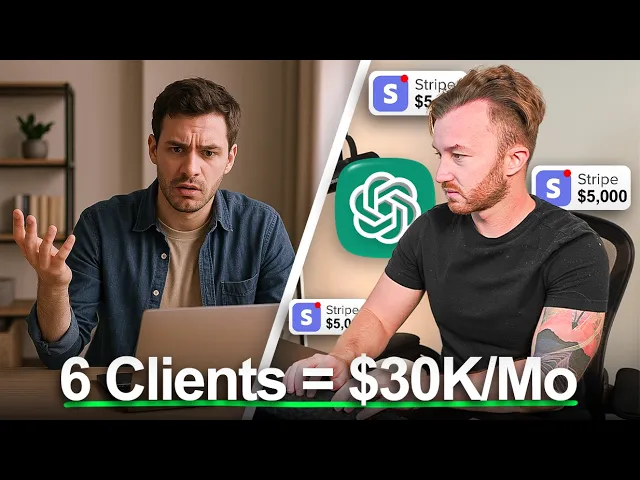
Six clients paying $5,000 each per month would produce $30,000 in monthly service revenue before expenses. That is the arithmetic behind this lesson, not a claim that a beginner has already signed those clients or will do so on a fixed timeline. What I want to explain is how I connect the service, its sales argument and the work involved in acquiring customers.
Sell a service the buyer already understands
I am not proposing that every beginner become a developer or build an AI app. My starting point is a service businesses already buy, with AI helping produce parts of the deliverables.
For ads and funnels, I list sales pages, published funnel pages, email flows, ad scripts, ad design, connecting automations and running the ads. These are the components of the service. Saying AI is involved does not explain what the client will receive.
Use examples and client context to guide the drafts
My production approach is to give AI examples of work that has performed and the relevant instructions for the new assignment. That can support sales copy, scripts and other marketing material rather than begin with a blank instruction.
Content scripting is another service I discuss. The client needs content connected to sales or sales calls, not simply a large view count. I also list newsletters, webinar funnels, ghostwriting and appointment setting as possible services; each still needs a defined deliverable and a way to perform it.
Explain the commercial reason to buy
I begin positioning with the return the buyer is trying to achieve. A fee only makes commercial sense to the prospect if the proposed work is worth more to that business than it costs.
I describe a quantified offer, risk reversal and an ROI calculator as ways to explain that proposition. The calculator is an illustration of assumptions and possible economics, not proof that a prospect will achieve the displayed return. An example promise in a sales lesson is not evidence that the result has already happened.
Sell the concept before asking the buyer to choose you
There are two questions in the sale: whether the strategy can work for the business, and whether I am the right person to perform it. Jumping to my credentials can miss a prospect who does not yet understand why email, content or a funnel would help at all.
My VSL outline includes the offer, examples, the economics, a picture of how the system works, the deliverables, the next step and frequently asked questions. Examples from other businesses can illustrate the concept, but they must not be presented as my own client results if they are not.
Client Ascension related reading: the value proposition guide develops the buyer's reason to want a service.
Show the work behind the outcome
A vague promise to run ads can hide how much the engagement actually includes. I call the alternative deliverable stacking: make the components of the work visible so the prospect can understand the scope.
My example covers messaging angles and ad scripts, matching landing pages, opt-in and pre-call emails, setter communication, application routing, a thank-you page, post-call sales assets, media buying, retargeting and newsletter broadcasts. It is an example package, not a requirement that every agency sell every item.
Keep quality review in the production process
I use AI for the marketing material described in the example, including email sequences, and I still quality-check the work. The point is to make production less labor-intensive while producing something useful for the actual offer.
Before prospecting, I want a chosen business model, a front-end offer, enough practice with the fulfillment work to understand it, a sales explanation and a defined package. Acquiring a client does not resolve an undefined delivery process.
Client Ascension related reading: the AI-assisted fulfillment guide examines intake, production, quality checks and reporting as a repeatable workflow.
Test personalized work with suitable prospects
For an operator without case studies, I suggest exploring different suitable markets instead of implying a niche-specific record that does not exist. I discuss looking for businesses whose customer value can support the service economics.
The early Dream 100 approach gives a prospect a useful deliverable, such as a drafted email sequence, alongside a direct offer. Research and AI-assisted drafting can help prepare that work, but its relevance to the recipient is what the prospect can inspect.
Add acquisition channels as resources develop
In the lesson I put personalized outreach first, automated cold email later and paid ads after the business has more resources. The distinction is between investing available time and committing money to acquisition.
That progression is a proposed plan, not a guarantee of a first client in thirty days or a fixed number of clients from each channel. The fee calculation at the beginning remains revenue arithmetic; actual profit depends on acquisition, fulfillment and the other costs of the business.
Adapted by Client Ascension with AI assistance from Daniel Fazio's lesson. The first-person narrative follows the source speaker’s account. Watch the original video





