
Business Growth
How I Build a Client-Acquisition Process for a One-Person Service Business
· Updated
For a one-person digital-service business, I separate getting clients into offer construction, generating leads and closing suitable prospects. My approach is to begin with a service and an acquisition method you can actually operate with your resources, then explain the delivery clearly rather than pretend to have experience you do not have.
Construct the offer around what the buyer is risking
I discuss cold email, ads and funnels, content, e-commerce email and AI automation as digital-service options. The reasoning is that many core deliverables involve text and digital assets that AI can help produce. That is the intended operating model, not proof that every service becomes expert-level, effortless or profitable through automation.
For a beginner without case studies, I recommend reducing the buyer's upfront risk through a defined guarantee or performance-based payment. A guarantee promises a specified result under agreed conditions; performance pricing ties payment to an event. Neither label is evidence that the client will obtain the result.
Define the actual billing event and infrastructure fee
My illustrative cold-email structure is a $500 monthly technology fee plus $200 to $400 per call. The technology fee funds domains, inboxes, leads and sending tools; it is not all retained as profit. I contrast that structure with asking for a flat retainer before the buyer has evidence about the provider.
Later in the same lesson, my detailed example specifies $250 per call that shows up, alongside the monthly technology fee. That is a different billing trigger from a call merely booked. These are historical examples of structuring terms, not a single current price list. The guarantee and performance language also help communicate the offer before the prospect agrees to speak.
Choose outreach to fit limited capital
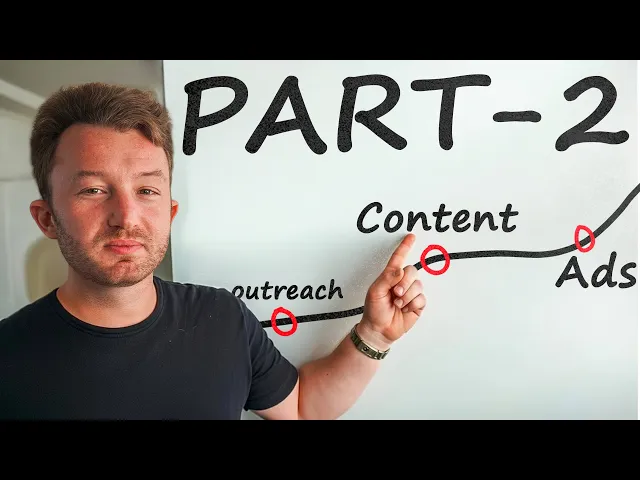
I compare content, outreach and ads in terms of time, money and speed. Content can keep working after publication but takes effort to build; outreach trades manual effort for direct conversations; ads require an advertising budget. For the beginner with more time than capital in this lesson, I recommend outreach.
I distinguish Dream 100 from high-volume cold email. In the former, I make a useful asset for a particular prospect before contacting them. In the latter, I send an offer at scale and create the requested explanation or audit after someone expresses interest. They can both use email, but the work and scale are different.
Find a buyer whose economics and market fit the service
Rather than ask for one permanently proven niche, I recommend looking beyond the obvious crowded targets. I discuss businesses selling high-value products or services because a new customer can matter more to their economics. That is an offer-selection argument, not a guarantee that an obscure industry will respond.
The example involving Kabrin is a source-reported account of targeting less-obvious markets, not a response-rate promise for every reader. Price of the client's product is also not profit or proof that the service fee pays for itself; delivery costs and actual closed business still matter.
Client Ascension related reading: the value proposition guide explains how the buyer's actual problem differs from the service label.
Make a specific asset and run a bounded learning exercise
For Dream 100, I suggest assets such as ad scripts, an email sequence, a sales page or a VSL script, tailored to the prospect. I describe generating these with a calibrated AI workflow or prompting against useful examples, then sending the finished document rather than just offering to make it later.
My proposed schedule is ten tailored outreaches per day for 30 days, trying a niche each day and learning which targets and messages produce a response. Client Ascension calculation note: the stated daily schedule totals 300 outreach messages; the source's later verbal total of 30 is inconsistent with those inputs. This is an activity plan, not a guaranteed client-acquisition result.
The lesson's illustrative time/cost and response-rate calculations are scenarios, not observed hourly earnings. Client Ascension evidence note: minutes, AI-credit spend, a recurring service fee and personal profit are distinct quantities; the source's inconsistent dollar-per-hour phrasing is not reproduced.
Fund and test automation instead of betting on one script
I normally suggest starting with a few clients from manual outreach before paying for a larger automated cold-email system. Domains, inboxes, lead data and a sending tool all have costs. I want the operator to understand those costs rather than assume high-volume outreach is free.
I compare lead lists to advertising audiences and email scripts to creative. Test different messages and calls to action: an interest question, an offer to send an explanation, or relevant case evidence. A previous winner does not remove the need to adapt as circumstances change.
Use discovery to reject poor-fit prospects
I tell beginners to be honest about being beginners, including when a performance arrangement compensates for the lack of a track record. Then discovery becomes an interview rather than a frantic attempt to sell everybody.
For cold-email delivery, I ask whether they actually want more calls, can handle them, have a reachable target market large enough for the channel, and sell something whose economics fit the acquisition cost. Somebody can run a successful business and still be a poor fit for this particular service.
Explain the product, the reasons and the next step
My delivery-stack example includes domains and inboxes, target-market lead research, different scripts, sending infrastructure, response handling, qualification and pre-call sequences. The point is to explain what is done and why each component is there, not just say that I send emails.
I suggest a sales deck or document that can be screen-shared so the prospect can follow the explanation. The historical training-event promotion and refund language in the lesson do not establish current dates, availability or program terms.
Client Ascension related reading: the higher-ticket presentation guide connects economic assumptions, honestly attributed evidence and deliverables.
Adapted by Client Ascension with AI assistance from Daniel Fazio's lesson. The first-person narrative follows the source speaker’s account. Watch the original video





