
Business & Marketing
The 7 Levels of Signing Clients
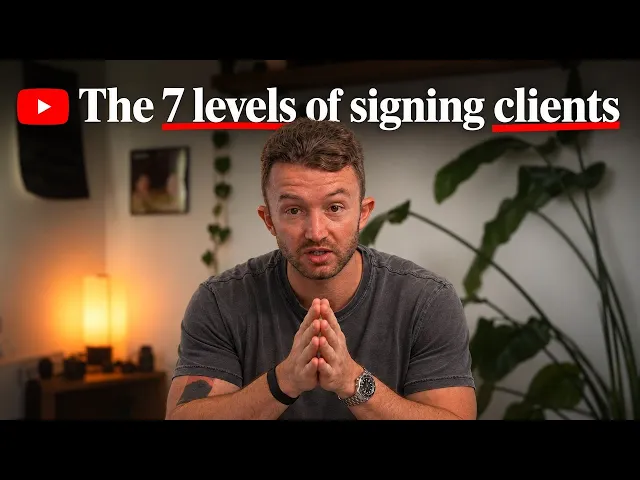
The seven levels of signing clients are waiting to get picked, pitching everyone, making a cold traffic offer, demonstration, trust assets, actual client acquisition systems and LTV maxxing. I use this framework to explain the difference between passive approaches and a repeatable way to acquire clients.
If you fix one thing first, start with the first practical step in my sequence: move from waiting to get picked into active outreach, then develop a specific cold traffic offer before you invest in demonstrations, trust assets and repeatable systems. Those are the practical steps as I lay them out, and a website or marketplace profile does not replace the outreach.
Waiting to get picked
At the first level, you put up a website or join a platform like Upwork or Fiverr and wait for clients to find you. That is the passive approach I call waiting to get picked.
The change is to move into active outreach instead of relying on inbound leads alone. A profile and a website do not replace that work.
Pitching everyone
The next level is a generic pitch: ‘I’m a full-stack marketer, I can do your marketing.’ You are describing your capabilities without making a specific, compelling offer.
I call this a non-cold-traffic offer. It is the problem to address when your outreach says what services you provide but does not name a clear outcome for the prospect.
Making a cold traffic offer
A cold traffic offer promises a specific result and includes risk reversal. The example I give is implementing a system and guaranteeing five additional clients: if they do not sign those clients, they do not pay.
That is an illustrative offer, rather than a result I am reporting for every client. The structure names the outcome and reduces the prospect’s risk, instead of stopping at a list of services.
Demonstrating the work
Demonstration means showing what you can do instead of only saying you can do it. My example is creating sample AI creatives for each brand you reach out to and sending them upfront.
You give the prospect an example of the work itself. That is the distinction between a claim about your capabilities and a demonstration of them.
Building trust assets
Trust assets are content on the internet that shows your expertise and social proof. LinkedIn posts, YouTube videos and Instagram reels are examples.
This is a separate part of the framework from sending sample work. The demonstration shows a prospect what you can do; the content builds a visible body of expertise.
Running an actual client acquisition system
An actual client acquisition system is repeatable. It includes a consistent cold outreach process, daily targets for leads, AI creatives and DMs, and a CRM to track the activity.
The contrast is doing tasks erratically without a structured process. The aim at this level is a set of acquisition activities you repeat and track.
Increasing client lifetime value
The final level is LTV maxxing: increasing the total value of each client over time. Upsells, down-sells and reducing churn are the methods I describe.
Instead of losing a client completely, you can offer another package or service. The relationship to watch is lifetime value relative to customer acquisition cost, or LTV:CAC. The goal is a higher lifetime value relative to what it costs to acquire the client.
Adapted by Client Ascension with AI assistance from Daniel Fazio's lesson. The first-person narrative follows the source speaker’s account. Watch the original video





