
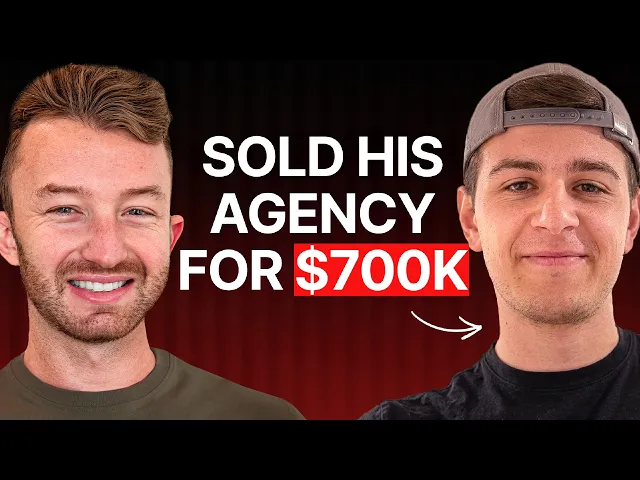
How We Changed Our Cold Email Offer and Sold the Agency
My partner and I built a cold-email agency, changed how we charged and eventually sold the business for a reported $700,000 cash. That was the agency sale amount, not my individual take-home profit after fees and taxes. The interview did not establish that net figure.
The path included earlier freelance-style work before the retainer agency. I treated the move to retainers as the real start of scaling, so the agency-growth timeline did not include every earlier experiment. The later upfront offer gave us cash to put into acquisition; it did not turn several months of service into one month of recurring revenue.
We started with a per-call offer and had to define what we sold
We began without case studies and offered cold email on a pay-per-call basis. Defining a qualified call caused friction. We also covered the initial tooling cost ourselves rather than charging a separate technology fee.
Twitter gave us a place to start: we had posted enough that somebody checking our profiles could see who we were. We made prospect lists, sent DMs and got an early client who sold LinkedIn automation. Once we had results, we could use them in later conversations.
Retainers changed the conversation with existing clients
Some per-call bills had become large enough that clients complained. We proposed a monthly retainer to the same clients so both sides had a more predictable arrangement. I described examples around $3,000–$3,500 a month, rather than one universal contract price.
We used our results and showed the process on sales calls. For acquisition we also used Apollo data and SmartLead to contact B2B companies. The tools were part of the historical setup, not a claim that copying them today guarantees the same outcome.
Client Ascension related reading: Brook's agency pricing article describes unresolved revenue-share pricing and delivery workload in another service business. It is a separate comparison of how the offer and responsibilities develop.
Upfront sprints changed cash timing before we added ads
We later tested charging roughly $9,000–$12,000 upfront for a three-month sprint. I had doubted people would pay that much at once, but we began selling it. That payment covered a service period; it was not a new monthly revenue rate just because the cash arrived together.
I said the extra upfront cash let us put more into acquisition, including ads. We had spent a long period around the same revenue range before that. The offer change and the acquisition work were part of the progression I described, not a controlled test proving one variable caused all the growth.
The early paid funnel was specific to business-loan brokerages
For the paid campaign we focused on business-loan brokerages, offering to help them reach business owners looking for funding. The funnel asked questions such as whether the prospect owned a brokerage and how many reps it had, then led to a booked call.
The early setup had no VSL or post-booking video. I reported starting near $100 a day and later moving toward $200 a day. That was a historical campaign description, not a current budget recommendation or evidence that every market can use the same minimal funnel.
Client Ascension related reading: the acquisition guide discusses channel fit and cost per client over the sales cycle. It gives context for assessing a channel rather than only counting booked calls.
Outsourcing our roles changed how we viewed the partnership
My role had been fulfillment and operations, while my partner handled sales. We had each owned half the business, but had brought in people to do those roles. That prompted a conversation about whether we should continue together or consider a sale.
It was the replacement sales role that was commission-based, not a statement that my partner's equity was a commission. Delegating the work also did not make the business run without any responsibility or operating cost.
The first offer was not the final sale
We rejected an initial offer around $90,000. A later discussion began with a much higher range and then an offer around $500,000. As the business continued growing during negotiations, we went back and forth until agreeing around $700,000.
The agreement took months of discussion, an LOI and further negotiation. I confirmed the cash sale in the interview, but did not provide the transaction documents, final fee breakdown, tax treatment or each partner's net proceeds.
Client Ascension related reading: the asymmetric offer article discusses service economics and positioning. It is related reading about an offer, not a valuation method or evidence of this sale price.
The practical lesson was the market and offer, over a longer horizon
My advice was to allow time for plateaus rather than compare every month with somebody else's headline. I also described how a weak offer in a very small market had held us back. A small market can work, but it does not remove the need for a compelling offer.
After the sale, I was building another lead-generation business using paid channels rather than cold email as the fulfillment mechanism. Owning a brokerage was an ambition, not something the interview established I had already done.
Client Ascension related reading: the AI Assisted Agency program page contains current offer details. The pricing, tools and campaign examples here describe our historical business, not current program terms or a promised exit for another owner.
Adapted by Client Ascension with AI assistance from Tyler's interview. The first-person narrative follows the source speaker’s account. Watch the original video





