
How I Built a Coaching Offer Alongside My Done-for-You Services
I'm Nick Verge. I had been selling done-for-you services, but I also wanted a done-with-you coaching offer supported by my personal brand. The change was not simply selling more of the same service; I had to build the offer and the systems behind a different way of working.
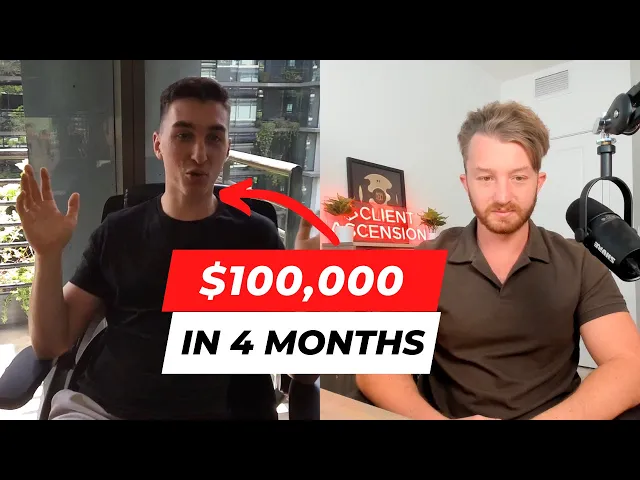
At the interview, I put the total I had made since joining Client Ascension at around $100,000 over roughly four or five months. That was an approximate cumulative account, not a $100,000 month, a profit figure or a reconciled financial statement.
I split the business between services and coaching
One area was changing how I worked with business clients. The other was realizing I could use a personal brand to sell a coaching offer rather than doing all the work for clients myself.
Those offers took time to build. My months were uneven, which is why I preferred looking at the business cumulatively. The interview's rounded figures for the separate offers were estimates, not an exact breakdown to add into a verified total.
The coaching offer needed more than a new sales page
I had run occasional coaching cohorts before, but I had not built the systems I now had for bringing people into the offer. We worked on the workshop, the offer, the program and getting people onto a schedule.
Once those pieces were in place, taking on a student felt more efficient. I used the analogy of a highway system: first build a route that makes the journey possible, then it becomes easier to move people through it. That was a description of my experience, not a measured time-saving claim.
I wanted a brand alongside outbound prospecting
I had used cold email and referrals through my career. Each time I needed business, I had to go back out and get it. I wanted to build a personal brand that could also bring people to me.
I liked the frame of a sales call where someone had chosen to approach me. Twitter was the platform I had developed at the time; LinkedIn, Instagram and YouTube were more work I still wanted to do. I had not completed all those channels.
Client Ascension related reading: the acquisition guide considers which channel fits an offer and how to evaluate cost per client over a full sales cycle.
I chose help around the things I wanted to improve
I was more likely to ask questions on calls than sit through every unit of a curriculum. I spoke with people about offers, Twitter and branding, and those were the areas where I felt I had improved.
That was the format that suited me. It does not mean everyone should learn the same way or that simply attending a call creates a result. The important part of my account was getting help on the work I was actually trying to build.
A partner took on the systems work I did not enjoy
I had been reluctant to partner with someone. Seeing how people could divide responsibility made the idea more concrete: I did not enjoy the data and systems side, and trying to force myself into that role was a headache.
I took on a partner who handled that side of the work. It was one of the practical changes I valued, alongside the offers and the brand. I did not disclose an equity split, operating agreement or a measured profit effect from the partnership.
Client Ascension related reading: Alex's fractional CFO case study discusses people and processes in a different service business. It is a comparison of operating decisions, not evidence of my financial result.
Adapted by Client Ascension with AI assistance from Nick Verge's interview. The first-person narrative follows the source speaker’s account. Watch the original video





