
Business Growth
What Changed as Our Businesses Reached a Million-Dollar Month
· Updated
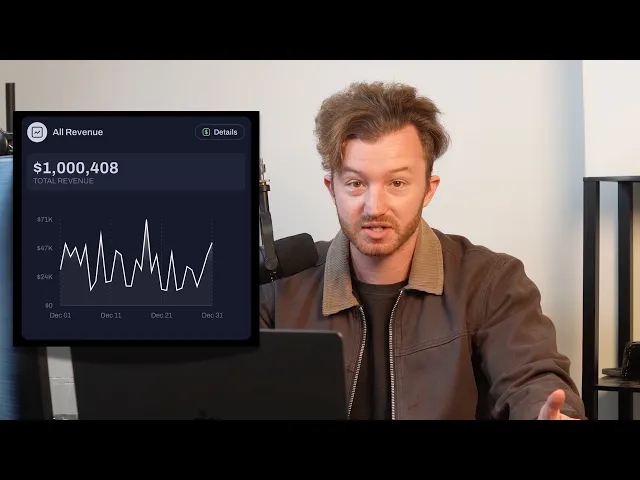
In the earlier story, I was around $200,000 a month across the businesses. In this update, I described a December month of $1 million from Client Ascension, Olympia and ListKit together. That is a historical combined business figure, not my personal monthly income or a recurring-revenue claim for a single company.
The useful part of the update is what changed: a new software company, more things to sell to an existing audience, fulfillment capacity and a continuing focus on acquisition. The later $3 million monthly target in the video was a goal, not an achieved result.
The software story included failed companies
I recap the path through an Instagram service, cold email as a service and an educational product, then building software around tools the audience needed. In this update, I also say the older software businesses failed; they were not all a set of continuing successes.
The new software business I discuss is ListKit, built with business partners including Oliver, who had been an early Client Ascension participant. I describe it as selling the lead-data component used in cold email campaigns.
Client Ascension related reading: the earlier business story provides the fuller account of the experiments that came before this update.
Keep the revenue mix distinct from personal take-home
At the time, I reported ListKit alone at more than $500,000 a month. I also described most of our money as coming from outside coaching, with Client Ascension, ListKit and Olympia forming the main business mix.
For the combined operation I gave a profit-margin figure of about 40%. That is a source-reported margin without a full accounting definition or independent verification; it should not be converted into an exact personal take-home figure.
I explained a willingness to trade some current margin for reinvestment and later growth. The higher margins I said could be possible by changing that choice were hypothetical, not the margin already being achieved.
More offers gave existing buyers another reason to buy
I describe previously being stuck with mainly one offer, then adding other services, lower-priced products and in-person events. The argument is that someone who bought before may want a different product even after leaving the original service.
That creates another possible route besides acquiring an entirely new customer every time. I want operators to consider what else fits people who already know the business, rather than assume a former client can never become a customer again.
Client Ascension related reading: the channel stacking lesson explains connecting offers and conversion mechanisms around an existing audience.
Proven demand comes before a novel idea
For an early service business, I emphasize selling something people already buy and explaining the tangible result. I recount a consulting conversation in which I challenged an unproven niche-and-service idea instead of assume novelty itself made it a good opportunity.
That is my argument for investigating demand before building the proposition. It does not prove that every unfamiliar idea fails or that market saturation is impossible; the practical question is whether there is evidence of people buying the thing you intend to sell.
Client Ascension related reading: the starting-again lesson considers how I would start over and build a business.
Delivery capacity can become the constraint on sales
I describe a founder who wants more clients but also knows every new sale creates hours of manual fulfillment. The operational response I argue for is hiring, training and managing people who can deliver, rather than leave the founder responsible for all of the work.
My revenue-stage boundaries are teaching observations, not universal ceilings. The useful connection is between being able to sell more and being able to fulfill what has been sold; neither task disappears when the business grows.
Keep acquisition and product development connected
My plan for further growth was to keep making content, doing outreach, running ads, developing more offers and collecting case studies from the work. I also describe downsells, upsells and different packages for prospects whose needs do not match the original retainer.
That is the plan I laid out at the time, rather than evidence that the future target had already happened. The historical program descriptions and participant examples in the video do not establish current offer terms or typical results.
Client Ascension related reading: the AI Assisted Agency program page contains current program information.
Adapted by Client Ascension with AI assistance from Daniel Fazio's lesson. The first-person narrative follows the source speaker’s account. Watch the original video





