
Business Strategy
How I Separate Agency Entry Offers From Hybrid Coaching Offers
· Updated
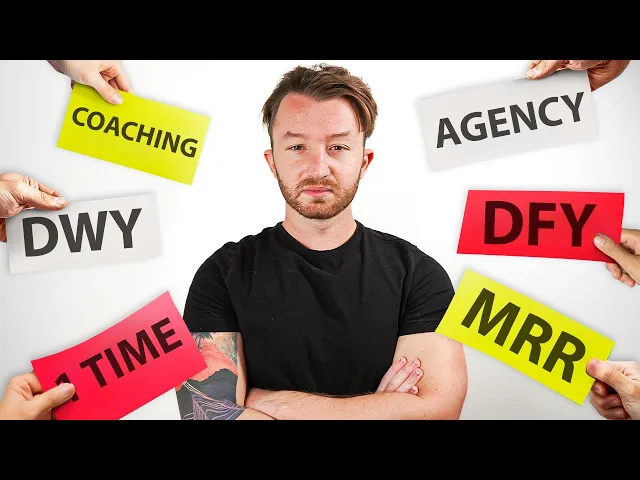
I split this lesson into two businesses with different packaging decisions. For an agency doing the work for a client, I recommended a trial or setup engagement before recurring service. For a coaching business, I recommended adding done-for-you implementation to make the offer a hybrid.
The source was a historical presentation about offers for 2025. Its program comparisons and market opinions describe what I was arguing then, not current prices, current contract terms or a guaranteed formula for every cold prospect.
A fixed engagement and a monthly commitment are different asks
My pricing argument was that a buyer can compare a fixed engagement with money already available, while a recurring price can feel like a commitment against future cash flow. That was the reasoning behind my preference for a defined starting period, rather than insisting the first transaction be a subscription.
The point was not that recurring work was undesirable. A trial or setup project can create a client relationship, and some of those clients can then choose continuing service. I was challenging the assumption that recurring billing must come first in order to build recurring revenue.
Lifetime value is not the same thing as the monthly label
I used a web-design example to show the problem. If a buyer mainly needs one website, putting that need into an ongoing unlimited-design service does not create another website need every month. In the scenario, the client gets the website and stops paying; the subscription label had not created lasting value for the client.
I contrasted that with charging for the website as a project and potentially selling another project when the client needs one later. That is why I urged looking at the value of the client relationship, not just the MRR number at the moment someone signs. These were examples for thinking about churn and payment timing, not observed retention figures from a particular cohort.
Client Ascension related reading: Corey’s design case study describes a Trello-based retainer and a planned move toward static-ad work. It provides a separate account of what clients request and what the team can repeatedly deliver.
The coaching offer has a different implementation question
For coaching and done-with-you businesses, I argued for a hybrid offer: keep the guidance, but add an implementation component in front of it. My reasoning was that the high-priced buyer I was trying to reach could be constrained by time rather than only money.
Done-for-you work changes what the buyer is purchasing. Instead of only learning how to build a funnel or write an ad, they can have part of that work produced for them. That is an offer-design decision with real work attached, not simply changing the name of a coaching package.
The Olympia comparison showed the kinds of tasks I meant
In the historical example, I compared the regular Olympia offer with Olympia Ultimate. I described funnel setup, ad scripts, a video sales letter, editing, follow-up sequences and automations as areas where the hybrid version included done-for-you work. It made the implementation difference concrete.
The comparison was my argument for what I expected to sell better to cold traffic. It was not a controlled experiment establishing a conversion multiplier.
Client Ascension historical-terms note: the prices and service inclusions in this historical presentation do not establish the program’s current terms.
Client Ascension related reading: Collin’s consulting case study describes adding consulting for in-house teams alongside an agency business. It is another example of shaping a service around the kind of help the buyer wants.
Match the structure to the buyer’s relationship with the business
I distinguished an audience that already watched my content from people encountering the offer through cold traffic. Someone familiar with the work can be more comfortable buying guidance; someone unfamiliar may place more value on having implementation included. That was my proposed distinction, not a rule describing every individual buyer.
These were two different changes: give agency customers a defined way to begin, and give coaching customers a hybrid with done-for-you work. Both were about what the buyer was being asked to commit to, rather than assuming the same retainer or coaching format fit every first conversation.
Client Ascension related reading: the acquisition guide explains matching a channel to an offer and evaluating cost per client through a complete sales cycle. Offer structure and acquisition economics need to be considered together.
Adapted by Client Ascension with AI assistance from Daniel Fazio's lesson. The first-person narrative follows the source speaker’s account. Watch the original video





